

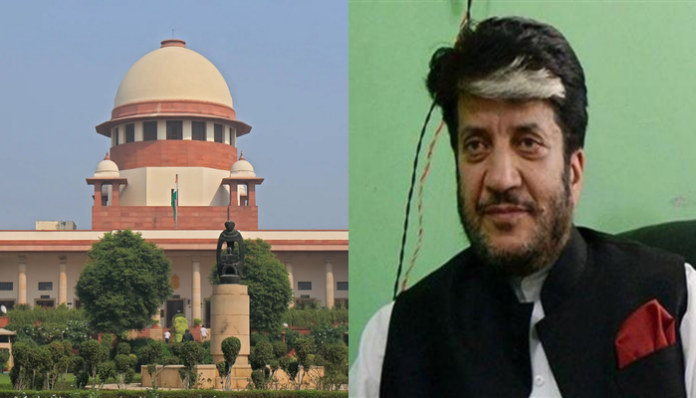
The Supreme Court on Thursday (12th March) granted bail to separatist leader Shabir Ahmed Shah, who was in jail in connection with a case of terror funding and the conspiracy to secede Jammu and Kashmir from India. A Bench of Justices Vikram Nath and Sandeep Mehta granted the relief to Shah, citing delays in the trial of the case involving him.
Shah, the head of the Jammu Kashmir Democratic Freedom Party, was arrested in June 2019. He was named as an accused in the second supplementary chargesheet filed by the National Investigation Agency on October 04, 2019. According to the NIA, Shah was one of the other accused, including Yasin Malik and Abdul Rashid Sheikh, who were members of terrorist groups and unlawful associations involved in secessionist activities in Kashmir. In 2023, the Ministry of Home Affairs banned his separatist organisation, the Jammu Kashmir Democratic Freedom Party.
The allegations against Shah include mobilising violent protests, including incidents of stone-pelting, paying tribute to the families of slain terrorists, receiving money through hawala transactions and raising funds through LOC trade used to “fuel subversive and militant activities”. The NIA said that Shah was involved in raising and channelling funds for separatist activities in Jammu and Kashmir, intending to further their secessionist objectives and create instability in the region.
Earlier, on July 7, 2023, Shah had approached the Delhi High Court challenging the rejection of his bail plea by a special court. The Delhi High Court rejected his bail plea, noting that the accusations against him appeared to be true. Division Bench comprising Justices Navin Chawla and Shalinder Kaur observed that the freedom of speech and expression could not be misused to deliver inflammatory speeches which harm the interests and integrity of the country. The court added that reasonable restrictions such as public order, decency, morality and incitement to an offence limit the scope of freedom of speech and expression.
