

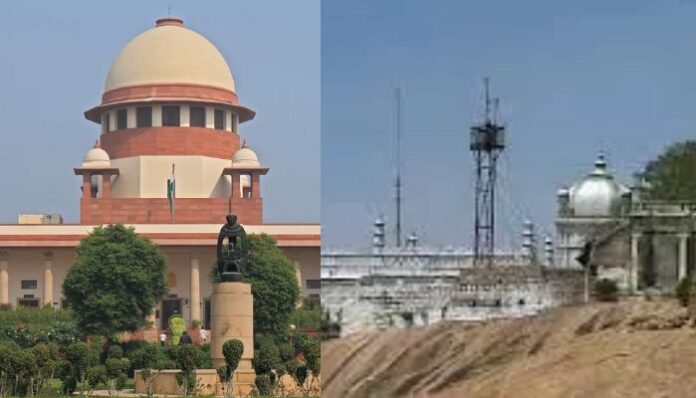
On Monday (9th February), the Supreme Court turned down a plea challenging Madras High Court orders that limit namaz and other prayers at the Nellithoppu area near Sikkandar Badhusha Avuliya Dargah. The dargah is located atop the Thiruppurankundram hill in the Madurai district of Tamil Nadu. As per the High Court’s directions, prayers at Nellithoppu are permitted only on Ramzan and Bakrid festival days.
The petition was heard by a Bench led by Justice Aravind Kumar. After a brief hearing, the apex court dismissed the plea and chose not to interfere with the High Court’s decision.
The Supreme Court has declined to interfere with the Madras High Court’s October 2025 judgment restricting religious practices at the Nellithoppu area atop the Thirupparankundram hills in Madurai district, Tamil Nadu. Upholding the High Court’s ruling, the apex court held that… pic.twitter.com/IBEpuZ47Z9
— ANI (@ANI) February 9, 2026
Petitioner questions limits on religious practice
Senior advocate Prashant Bhushan, appearing for the petitioner Imam Hussain, argued that the High Court had crossed “constitutional limits” by restricting prayer to just two days in a year. He pointed out that the High Court had allowed Muslims to offer prayers at Nellithoppu only during Ramzan and Bakrid so that it would not disturb the traditional pathway leading to the Kasi Viswanathar Temple.
According to the petitioner, the High Court’s order was based on an understanding reached during a peace committee meeting to prevent law and order problems. Mr Bhushan argued that this understanding was meant to be temporary but was wrongly turned into a permanent judicial rule.
He submitted that an administrative compromise could not be converted into a constitutional restriction on religious practice. The High Court, he said, did not rely on any specific law while deciding when namaz could or could not be offered.
Dispute over ‘essential religious practice’
The petition also challenged the High Court’s observation that offering namaz at the Nellithoppu area was of “recent origin.” Countering this, the plea argued that Article 25 of the Constitution, which guarantees freedom of religion, does not require a practice to be followed from time immemorial to receive protection.
The petitioner said the only test should be whether a practice is genuine, religious in nature, and not prohibited by law. Namaz, the plea stressed, is a core and well-recognised religious practice of Islam, performed daily by believers.
Concerns about access to temple pathway
The High Court had earlier reasoned that allowing large numbers of people to gather for prayers at Nellithoppu could block the pathway leading to the Kasi Viswanathar Temple. It also said this could amount to encroachment on temple land and violate a civil court decree passed on 25th August, 1923.
The 10th October, 2025, order was passed by a third judge of the Madras High Court after a division bench delivered a split verdict on 24th June, 2025, over the issue of prayer restrictions.
In the Supreme Court, the petitioner argued that limiting namaz to only two days a year was arbitrary and went against the spirit of Article 25, which protects the continuous practice of faith. He said the order placed an unfair burden on one religious community and violated equality before the law.
Imam Hussain also stated that he is a regular worshipper at the Hazarath Sultan Sikkandar Badhusha Avuliya Dargah and the adjoining prayer space at Nellithoppu. According to him, the High Court’s orders have effectively stopped him from offering namaz there on regular days.
The plea claimed that the restriction affected dignity, personal liberty, freedom of conscience, and the right of the religious denomination to manage its own affairs under Article 26. Despite these arguments, the Supreme Court declined to take up the matter, letting the High Court’s order stand.
