

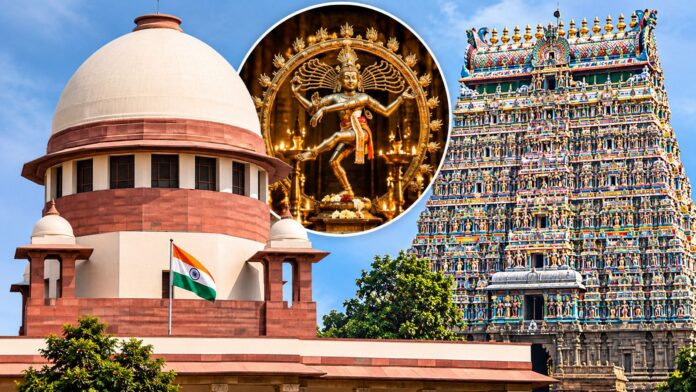
The Supreme Court on Wednesday (November 4) stayed a Madras High Court order directing the formation of a five-member Board of Management to take over the administration of the historic Chidambaram Nataraja Temple in Tamil Nadu from its hereditary custodians, the Podhu Dikshitars.
A bench comprising Justice Aravind Kumar and Justice Vipul Pancholi passed the interim order while hearing a petition filed by the Podhu Dikshitars challenging the High Court’s October 30 judgment.
The Madras High Court had ordered the constitution of the management board while disposing of a batch of petitions concerning the administration of the Sri Sabanayagar Temple, popularly known as the Chidambaram Nataraja Temple. The High Court had cited allegations of maladministration and held that judicial intervention was necessary to address concerns surrounding the temple’s management.
Under the proposed arrangement, the five-member board was to be headed by retired Madras High Court judge Justice V Bharathidasan as Chairman, with another former judge, Justice R Suresh Kumar, serving as Co-Chairman. Retired IAS officer C Rajendran was named as a member. The Secretary of the Podhu Dikshitars and the Secretary of the Tamil Nadu Hindu Religious and Charitable Endowments (HR&CE) Department were to be the two ex-officio members.
The High Court had directed the board to assume control of the temple’s administration “till the ill is cured”.
Its responsibilities included supervising the temple’s properties, financial records, heritage conservation and other administrative matters. It was also tasked with taking steps to recover encroached temple properties, collect outstanding rental dues, ensure proper maintenance of accounts and provide devotees with equal opportunities to have darshan from the Kanagasabai.
However, the High Court had drawn a distinction between administrative supervision and religious affairs. It clarified that the performance of daily rituals and organisation of periodic festivals would continue to remain exclusively within the domain of the Podhu Dikshitars, in accordance with established customs and practices.
Challenging the High Court’s intervention, the Podhu Dikshitars approached the Supreme Court, arguing that transferring the temple’s administration to an external board violated their constitutional right to manage religious affairs under Article 26 of the Constitution.
With the Supreme Court now staying the High Court’s direction, the proposed takeover of the temple’s administration by the five-member board has been put on hold pending further proceedings.
