

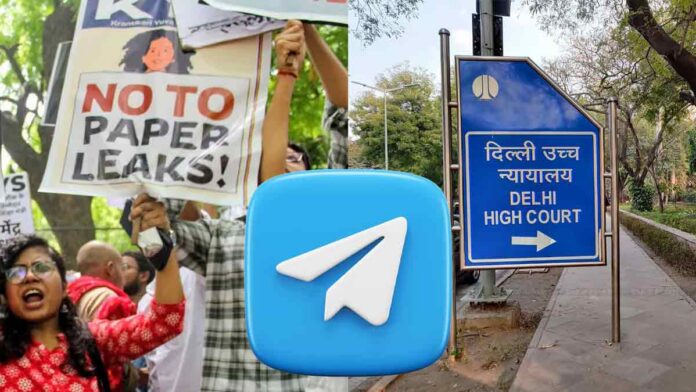
Messaging platform Telegram has approached the Delhi High Court against the Central government’s decision to temporarily block its services in India ahead of the NEET-UG 2026 re-examination. The matter was raised on an urgent basis before a vacation bench of Justice Tejas Karia on Tuesday, 16th June.
#BREAKING
— Nabila Jamal (@nabilajamal_) June 17, 2026
TELEGRAM MOVES DELHI HIGH COURT AGAINST CENTER'S DECISION TO BAN THE APP AHEAD OF NEET-UG RETEST ON JUNE 21
The matter was mentioned before Justice Tajas Karia, who agreed to hear it today
The government invoked Section 69A of the IT Act on June 16, ordering Apple… pic.twitter.com/4m4d2FslDu
Advocate Madhav Khosla, appearing for Telegram, informed the court that the restriction has affected more than 150 million users across the country. Taking note of the request, the court agreed to hear the case later in the day.
The government restricts access till June 22
The Ministry of Electronics and Information Technology (MeitY) issued an order under Section 69A of the Information Technology Act, 2000, directing internet service providers and telecom operators to restrict access to Telegram in India until 22nd June.
Following the order, access to the platform was reportedly blocked by telecom operators, while the application’s listing was also removed from major app stores.
In a separate direction, the government instructed Telegram to disable the message-editing feature for already posted messages until 30th June.
Why the government took action
The temporary restriction came after concerns were raised over the use of Telegram by organised cheating networks linked to the NEET-UG controversy.
Authorities said several Telegram channels were being used to circulate leaked and fake question papers, coordinate cheating activities and misuse the platform’s message-editing feature to alter timestamps of posts. The government maintained that the move was necessary to protect the fairness of the NEET-UG re-examination scheduled for June 21.
The action was reportedly taken following a request from the National Testing Agency (NTA), which said the platform was being used to mislead and defraud students appearing for the re-test.
Compared to other messaging platforms like WhatsApp, Telegram is preferred by criminals in activities such as leaking papers because it allows completes annonymity. Tracking users of the platform is very difficult. Moreover, as it allows editing old messages, many criminals were found editing earlier messages to include images of question papers after the exams were over. They did this to claim that they had already leaked the paper, making people believe that they have access to such question papers.
Telegram responds to the ban
Telegram founder Pavel Durov criticised the government’s decision, saying the platform had already removed hundreds of channels connected to examination leaks and scams.
He argued that the restriction affects millions of genuine users who rely on Telegram for communication and noted that people involved in illegal activities could simply move to other online platforms.
NTA defends decision
The NTA defended the temporary block, stating that the measure was aimed at ensuring a fair and secure examination process. According to the agency, the restriction is limited in duration and is expected to be lifted after the NEET-UG re-examination is completed.
The agency believes the step is necessary to prevent the spread of misleading content, leaked material and other activities that could compromise the integrity of the examination.
Court to examine the legality of the order
The Delhi High Court is expected to examine whether the government’s action is legally justified and proportionate to the concerns raised. The court may also consider the wider impact of the restriction on millions of Telegram users and digital communication services across the country.
The case comes amid heightened scrutiny of online platforms following the cancellation of the original NEET-UG examination over paper leak and examination irregularity concerns.
