

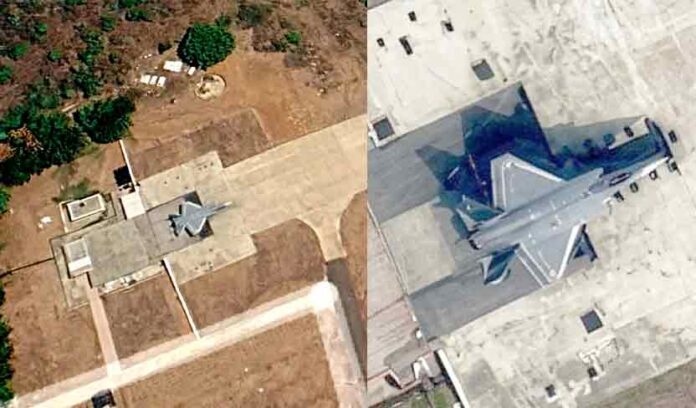
Recently, a satellite image has revealed the presence of a full-scale engineering model of India’s Advanced Medium Combat Aircraft (AMCA) at a DRDO testing facility in Hyderabad. This image might be a lovely surprise for our neighbouring country. The AMCA is India’s ambitious indigenous fifth-generation stealth fighter jet project. It is directly designed to strengthen the country’s air combat capabilities in the coming decades. The model has reportedly been spotted at DRDO’s ORANGE radar cross-section testing facility, a specialised site where scientists evaluate how visible an aircraft is to enemy radar systems.
Such testing is a crucial part of developing stealth aircraft, as it helps engineers identify areas that may reflect radar signals and make design improvements to reduce detectability. While the aircraft seen in the satellite image is not a flying prototype, its presence at the facility suggests that the AMCA programme has entered an important stage of development. The testing is expected to provide valuable data that will help refine the aircraft’s stealth characteristics before the first prototypes are built and flown. The development is seen as another significant step forward in India’s efforts to build its first homegrown stealth fighter aircraft.
What is AMCA?
The Advanced Medium Combat Aircraft (AMCA) is India’s ambitious indigenous fifth-generation stealth fighter jet programme being developed by the Aeronautical Development Agency (ADA) in collaboration with the Defence Research and Development Organisation (DRDO). The aircraft is intended to become one of the most advanced combat platforms in the Indian Air Force. It is expected to provide capabilities such as stealth, advanced sensors, internal weapon bays and network-centric warfare.
During Aero India 2025, the full-scale model of the aircraft was publicly showcased for the first time, attracting significant attention from defence experts and aviation enthusiasts. The model was manufactured by Hyderabad-based VEM Technologies and was displayed to provide a glimpse into India’s future fighter aircraft programme. The project represents India’s effort to join the small group of nations capable of designing and producing their own stealth fighter aircraft. Once operational, the AMCA is expected to play a key role in strengthening India’s air power and reducing dependence on foreign combat aircraft for future requirements.
A Crucial Step Before First Flight
The spotting of the AMCA engineering model at DRDO’s Radar Cross-Section (RCS) testing facility is an important milestone in the development of India’s first indigenous stealth fighter aircraft. Although the airframe seen in the satellite imagery is not a flying prototype, it’s key to get the aircraft ready for future flight trials. Full-scale engineering models are built to help engineers verify various aspects of an aircraft’s design before the production of the actual prototypes.
With these models, teams can ensure that various components fit into the airframe perfectly, make sure internal components can be integrated efficiently, and discover potential design problems early on. Internal bay layout, antenna and sensor placement etc are evaluated in such models.
The engineering model is also used to evaluate maintenance requirements and ergonomics. So, the engineer can examine whether technicians will be able to access key components for repairs and servicing. Designers can assess the overall layout and practicality of the aircraft’s internal structure.
Such studies help reduce future operational and maintenance challenges. By conducting extensive evaluations on the full-scale model, developers can identify and resolve issues before moving to the far more expensive and complex stage of building the actual aircraft. This process significantly reduces technical risks and improves the chances of a successful prototype development program.
According to current projections, the first AMCA prototypes are expected to be rolled out between 2028 and 2029, with the aircraft’s maiden flight targeted around 2029. Notably, the union government is yet to finalise the private partner to build the prototypes. The defence ministry has issued a request for proposal (RFP) to Tata Advanced Systems, a L&T-BEL-Dynamatic consortium, and a Bharat Forge-BEML-Data Patterns consortium. One of the three bidders will be selected for the ₹15,000 crore project to build five AMCA prototypes at a new greenfield facility in Andhra Pradesh.
Stealth Testing Explained: Why Radar Cross Section Matters
One of the most important features of a fifth-generation fighter aircraft is its ability to avoid detection by enemy radar systems. For achieving the capability, aircraft developers must carefully study and minimise the aircraft’s Radar Cross Section (RCS). It is a measure of how visible an object appears to radar. In simple terms, radar cross-section means the amount of radar energy reflected back to a radar system when electromagnetic waves strike an aircraft. A larger radar signature makes an aircraft easier to detect and track, while a smaller radar signature allows it to remain hidden for longer periods, increasing its chances of completing missions without being intercepted.
This is why stealth aircraft undergo extensive RCS testing during their development. Engineers need to identify which parts of the aircraft reflect the most radar energy and make design modifications to reduce these reflections. The shape of the aircraft, placement of air intakes, alignment of surfaces, and use of radar-absorbent materials all play a crucial role in determining its radar visibility.
The AMCA engineering model has reportedly been spotted at DRDO’s ORANGE (Open Range) facility in Hyderabad. It is a specialised testing range designed to conduct Radar Cross Section evaluations. Such facilities are equipped with sophisticated instruments that transmit radar waves toward an aircraft from different angles and then measure the strength of the signals reflected back.
By analysing these reflections, scientists can create a detailed map of the aircraft’s radar signature. Areas that produce strong radar returns can then be redesigned or refined to improve stealth performance. This process helps engineers understand how the aircraft would appear to enemy radar systems under real-world conditions. Reducing radar visibility is critical because it allows a fighter aircraft to operate deeper inside hostile airspace with a lower risk of detection.
For a future stealth fighter like the AMCA, achieving a low radar cross section is essential to enhancing survivability, increasing mission effectiveness, and ensuring that the aircraft can compete with other advanced fifth-generation fighters being developed and operated around the world.
Testing an Evolving Design
It is important to note that the AMCA model seen in the satellite imagery does not represent the aircraft’s final design. The engineering model displayed at Aero India 2025 was based on an earlier configuration of the aircraft. Since then, the Aeronautical Development Agency (ADA) has reportedly incorporated several refinements, including the adoption of Diverterless Supersonic Inlets (DSI), which can improve both aerodynamic performance and stealth characteristics.
Such design changes are common in advanced fighter jet programmes, where multiple iterations are tested before the final configuration is frozen.
The Road Ahead for AMCA
The AMCA programme is expected to progress in two phases. The initial AMCA Mark 1 variant is planned to be powered by the American GE F414 engine, while a more advanced Mark 2 version is expected to feature a powerful indigenous engine currently under development.
France’s Safran and the UK’s Rolls-Royce are in the fray for developing India’s next-generation fighter engine to be used in AMCA. If current timelines are met, the first prototype could take to the skies around 2029 with GE engine, with induction into the Indian Air Force expected in the following decade.
Conclusion
The satellite image itself doesn’t show any dramatic breakthrough, but it gives a rare glimpse into a crucial phase of India’s most ambitious fighter jet project. The fact that the AMCA engineering model is at a specialised radar testing facility points to crucial stealth validation work being carried out. With India making progress with its first home-grown fifth-generation stealth fighter, every such milestone brings the programme closer to reality.


