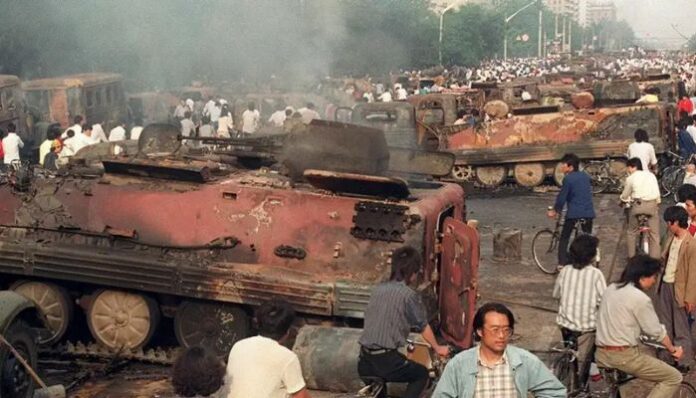
Democracy has its own flaws, but it is better to have a flawed “by the people, of the people, for the people” democratic system of governance than a perfect-from-the-outside autocracy. People across many countries have protested, fought, and even died in pursuit of overthrowing autocratic regimes. One such courageous but unsuccessful movement took place in China in 1989. The 4th of June marks 37 years of the Tiananmen Square massacre, which the Chinese Communist Party downplays and calls the ‘June Fourth Incident’.
The Tiananmen Square protest began in mid-April 1989 and culminated in a violent military crackdown between 3rd and 4th June 1989. China has, despite the undercurrents, never witnessed such massive pro-democracy protests again.
As the CCP continues to sell China as a Communist Utopia, it is pertinent to remember the dark chapter in China’s history that shows the CCP regime got itself a new lease of life in 1989 by murdering thousands of its people.
The Tiananmen Square protests: In pursuit of democracy
In 1949, Republican leader Chiang Kai-shek retreated to Taiwan after Communist leader Mao Zedong won the civil war and established the ‘People’s Republic of China’. From Chiang Kai-shek, Mao, Deng Xiaoping, and during the Tiananmen Square massacre, to President Xi Jinping now, China has never seen democracy. The only major attempt at establishing democracy in China began in April 1989.
The pro-democracy protests were triggered after the death of a reformist former Communist Party General Secretary, Hu Yaobang on 15th April 1989. He was seen as sympathetic to students. Mourners gathered in large numbers in Beijing’s Tiananmen Square. This gathering soon evolved into broader protests against inflation, corruption, censorship, and demands for political reforms, including freedom of speech, press freedom and overall accountability from the Communist regime.
While tens of thousands of university students gathered at Tiananmen Square, the CCP mouthpiece, People’s Daily, labelled the protests a “conspiracy to sow chaos”.
By May 1989, nearly 1 lakh students gathered at the Square, and a hunger strike began on 13th May. The protesting students received massive public support, and workers and ordinary citizens soon joined them. While moderate leaders like Zhao Ziyang visited the protestors sympathetically, Paramount leader Deng Xiaoping, and Premier of China, Li Peng prevailed.
Martial law declaration and the infamous Tiananmen Square massacre
Deng Xiaoping and other Communist Party leaders saw the Tiananmen Square protests as an existential political threat and agreed to use coercive measures.
Acting out of the paranoia of losing if the Tiananmen protests extended to other parts of the country, the State Council declared martial law on the 20th of May and deployed over 300,000 troops on the streets of Beijing. The martial law was formally declared by Li Peng, the Premier of China.
The armed troops moved inside Beijing and advanced into central parts of the capital city in the wee hours of the 4th of June 1989. These People’s Liberation Army (PLA) troops killed both demonstrating students and ordinary civilians. The Chinese soldiers did not even spare the bystanders.
While the Chinese official figures claim that around 200-300 people, including PLA soldiers, died in the crackdown, independent sources estimate the death toll to be above 10,000. Thousands were injured or arrested by the CCP after crushing the threat to its throne.
The CCP-PLA crackdown killed thousands of Chinese citizens and crushed the hope for a dawn of democracy. Zhao Ziyang, the political leader sympathetic to the movement, was purged and placed under house arrest.
The Tiananmen Square massacre was a turning point in the recent history of China; the CCP ensured that political liberalisation halted. The CCP regime rolled out economic reforms, which experts read as an effort to make the people forget the massacre of their own and move on in the glitter of the economic boom.
Dissent had no space in China, not in 1989 and not even in 2026. Every year, the Chinese government shows its gratitude to the forces for their sacrifice. However, with justifications, villainization, ‘foreign conspiracy’ propaganda, and every other tactic at hand, the CCP have tried their best to wipe out the history of the Tiananmen massacre.
The CCP pays tribute to the PLA soldiers who were killed while they were out to murder the protestors; however, it often places restrictions on Tiananmen Mothers, the mothers of the students who were killed during the 1989 massacre, to visit the Wanan cemetery, where their children are buried. The CCP’s heartless ban imposed on 4th June 2026 has been widely criticised across the world.
Over the years, the CCP has attempted to concoct an apocryphal narrative that the protesting students were pro-US and were acting against the Communist regime at the US’s behest. The Communists have long been trying to establish a narrative that the Tiananmen Square protests were a US regime change operation that they thwarted with an iron hand.
Indian communists sided in silence with their Chinese comrades as the latter killed students in 1989
Indian communists harbour deep loyalty, respect, and ideological commitment towards Communist regimes across the world, especially China. The Communist leaders in India look up to China as an ideal state. Perhaps, it was due to this delusion that Communists in India chose convenient silence over the 1989 Tiananmen Massacre rather than joining the international community in condemning the CCP’s slaughter of its own dissenting people.
After two years of disgraceful silence, in January 1992, the CPI(M) adopted a resolution at the 14th Congress, Madras. The party lauded the CCP for “successfully” crushing the Tiananmen pro-democracy protests.
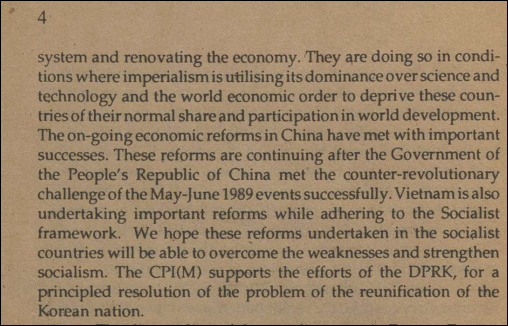
The same CPIM in its 20th congress document- “Resolution on certain Ideological issues”, downplayed the Tiananmen Massacre by calling it an “internal turmoil” in China and instead of calling it a massacre, called it “Tiananmen Square development”. The CPIM dismissed the Tiananmen protests and the massacre as China’s internal matter, and even called the protestors ‘troublemakers’.
“Such an imperialist attempt to internally subvert socialism in the People’s Republic of China in 1989 was successfully thwarted by the CPC and the PLA,” the CPIM said.
Communist student groups in New Delhi’s Jawaharlal Nehru University used to call the Chinese students who protested at Tiananmen Square, ‘CIA lackeys, juvenile delinquents, and bourgeois reactionaries’. While many celebrated the PLA crackdown, others simply dismissed the massacre as nothing but lies spread by the communism-hating Western media.
In fact, Sitaram Yechury, a known communist leader, had even claimed that “not a drop of blood was shed at Tiananmen Square.”
Communists in India have always prioritised ideological loyalty over human rights. The CCP does the same. Apparently, it is in the Communist ideology itself.
The CCP ensured near-total erasure of the Tiananmen events domestically, banned discussions, commemorations, or even indirect references online and offline. The CCP even deploys AI tools to scan for patterns or indirect references to the Tiananmen Square massacre. The Chinese youth know little to nothing about the 1989 massacre due to internet firewalls, sanitised school curricula, and media control. Mourners, activists, martyrs’ families, all face harassment and arrests even decades later for daring to even talk about the events of the Tiananmen Square killings.
In 2021, Xiaohongshu, an Instagram-like startup of China, shared a post on June 4, the anniversary of the 1989 Tiananmen Square crackdown, and wrote, “Tell me loudly, what is the date today?” The post was taken down quickly, and the company faced an investigation from local authorities.
Not much has changed in China. The Communist regime saw the Tiananmen protests as an existential threat to its power, and three decades later, they continue to see the truth and the memories of the 1989 massacre as a threat to its power.