

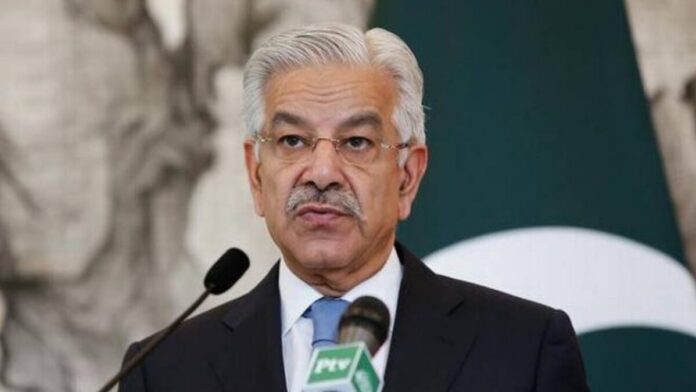
Pakistan Defence Minister Khawaja Asif has triggered a fresh political storm after branding protesters in Pakistan-occupied Kashmir (PoK) as “enemies like India” while defending Islamabad’s violent crackdown on anti-government demonstrations that reportedly left at least 14 activists dead.
In an interview with a local television channel, Asif did not distinguish India and those protesting against Pakistan’s administration in PoK, rejecting any possibility of negotiations with the demonstrators.
“I put the protesters in the same category as India and consider them also as enemies like India,” Asif said, adding that they were “enemies of Pakistan.”
The remarks came in the aftermath of one of the deadliest crackdowns witnessed in PoK in recent years. Pakistani security forces allegedly opened fire on a protest march organised by the banned Joint Awami Action Committee (JAAC), a group spearheading the ongoing agitation against Islamabad’s policies in the region.
Protest march turns deadly
On Tuesday, thousands of JAAC supporters marched from Rawalkot towards Muzaffarabad, demanding the abolition of 12 legislative assembly seats reserved for Kashmiri refugees. The group argues that the arrangement enables Islamabad-backed political parties to influence government formation in PoK, thereby undermining the political rights of residents. According to the protesters, only those residing in the region should decide its political future.
The JAAC claimed that nearly 5,000 people participated in what it described as a peaceful march when Pakistani security personnel opened fire without provocation. The organisation alleged that at least 14 activists were killed and over two dozen others sustained injuries. Among those killed was Usman Nazir, the younger brother of JAAC founding member Umar Nazir.
The group accused Pakistani forces of resorting to “unprovoked fire” against unarmed demonstrators.
Islamabad, however, offered a contrasting account, claiming that the protesters were carrying sophisticated weapons and attacked security personnel first, prompting the security response. These competing claims have not been independently verified.
Violence escalates amid controversial elections
The latest bloodshed has further inflamed tensions in PoK, where protests have continued for weeks. According to multiple reports, more than 80 people have been killed since demonstrations erupted on June 5, with casualties rising steadily following successive security operations. Even before the latest firing, reports suggested that around 40 people—including 34 protesters and six security personnel—had already lost their lives.
The crackdown coincided with the first phase of elections to the so-called legislative assembly in PoK. Polling was marred by violence in several constituencies, with reports of clashes, ballot boxes being looted, and allegations of electoral rigging despite heavy deployment of security forces.
India rejects Pakistan’s electoral exercise
India dismissed the election process in PoK as an attempt by Pakistan to legitimise what it describes as its illegal occupation of the region.
Addressing the weekly media briefing, Ministry of External Affairs spokesperson Randhir Jaiswal said the electoral exercise could not alter India’s long-standing position.
“The current cosmetic electoral exercise is nothing but an attempt by Pakistan to camouflage its illegal occupation and hide its grave human rights violations in the region,” he said.
Reiterating New Delhi’s official position, Jaiswal said the entire Union Territories of Jammu and Kashmir and Ladakh, including the areas under Pakistan’s control, remain an integral and inalienable part of India.
The MEA also argued that the continuing unrest in PoK stems from deep-rooted economic and political grievances rather than isolated law-and-order issues.
“As we have stated earlier, the ongoing mass protests in Pakistan-occupied Jammu and Kashmir are the direct consequences of Pakistan’s economic exploitation, its denial of the people’s fundamental rights, and its administrative oppression,” Jaiswal said.
Months of simmering public anger
The current agitation is the culmination of months of public resentment across PoK. Residents have repeatedly taken to the streets over soaring inflation, rising prices of essential commodities, prolonged electricity shortages and allegations of administrative neglect.
What began as protests demanding affordable electricity, subsidised wheat flour and better governance has gradually transformed into a broader movement challenging Islamabad’s control and administration of the territory. As security operations intensify and political rhetoric hardens, the unrest in PoK shows little sign of subsiding.
