

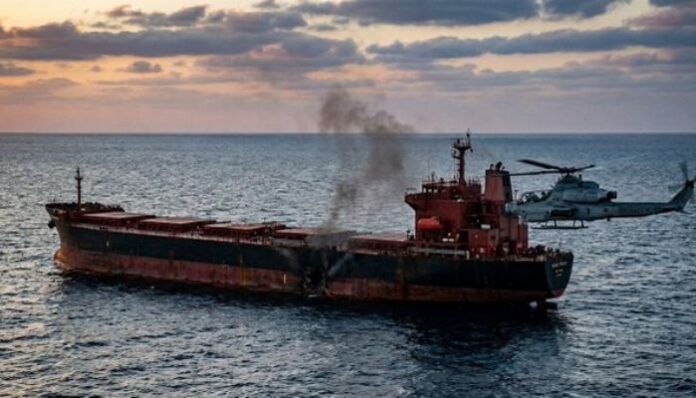
U.S. forces have used a Hellfire missile to stop a cargo vessel that was sailing toward an Iranian port, marking another step in Washington’s ongoing enforcement of its blockade against Iran.
— U.S. Central Command (@CENTCOM) May 30, 2026
According to the U.S. Central Command (CENTCOM), the Gambia-flagged vessel M/V Lian Star was travelling through international waters in the Gulf of Oman on 29th May when it was intercepted by American forces. The ship was reportedly on its way to an Iranian port.
More than 20 warnings
CENTCOM said U.S. personnel contacted the vessel’s crew multiple times and issued more than 20 warnings. The crew was informed that the ship was violating the U.S. blockade on Iranian ports and was asked to change course.
When the vessel continued its journey despite the warnings, a U.S. aircraft launched a Hellfire missile at the ship’s engine room. The strike disabled the vessel, preventing it from reaching Iran.
Part of wider blockade enforcement
The action is the latest in a series of operations carried out by the United States since the blockade on Iranian ports was imposed in mid-April. CENTCOM said U.S. forces have so far disabled five commercial vessels and redirected 116 others while enforcing the restrictions.
Shipping data from MarineTraffic identifies the M/V Lian Star as a general cargo vessel that operates on trade routes across the Persian Gulf and other parts of Asia.
The blockade was introduced after negotiations that began in late February failed to produce a broader agreement between Washington and Tehran, despite a ceasefire remaining in place.
Previous operations against Iran-Bound Ships
The United States has carried out several similar operations in recent weeks. Centcom said that U.S. forces have disabled five commercial vessels and redirected 116 to fully enforce the blockade as a ceasefire with Iran remains in effect.
On 8th May, U.S. forces disabled the Iranian-flagged oil tankers M/T Sea Star III and M/T Sevda before they could enter an Iranian port. According to CENTCOM, a U.S. Navy F/A-18 Super Hornet launched from the USS George H.W. Bush fired precision munitions into the vessels’ smokestacks.
Earlier, on 6th May, another Iranian-flagged tanker, M/T Hasna, was stopped after a U.S. Navy F/A-18 Super Hornet from the USS Abraham Lincoln fired several 20mm cannon rounds that damaged the ship’s rudder.
Strait of Hormuz remains a flashpoint
The blockade continues to be one of the biggest points of tension between the United States and Iran. While Washington says the measures are aimed at limiting Iran’s maritime trade and increasing pressure on Tehran to return to negotiations, Iran argues that the blockade violates the ceasefire agreement.
The dispute has also affected the Strait of Hormuz, one of the world’s most important routes for global oil and gas shipments. Iran has tightened its control over the strategic waterway, and recent weeks have seen exchanges of fire between Iranian and U.S. forces.
In April, President Donald Trump stated that commercial traffic through the Strait of Hormuz had resumed, but made clear that the U.S. blockade on Iranian ships and ports would continue. U.S. officials later clarified that the blockade targets vessels entering or leaving Iranian ports rather than shutting down the Strait of Hormuz itself.
Iran has repeatedly called for the restrictions on its ports to be lifted, saying that doing so is necessary for any long-term peace agreement. However, efforts to reach a broader settlement and fully ease tensions in the region have yet to produce a breakthrough.
