

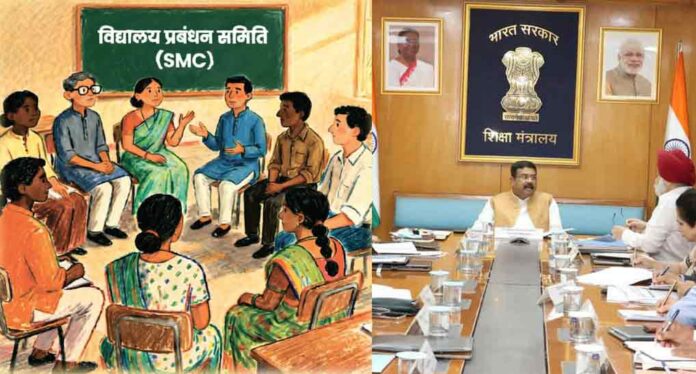
The Union Ministry of Education has issued a clarification amid concerns from private unaided schools and minority institutions over the recently launched School Management Committee (SMC) Guidelines 2026. In an official statement on X, the Ministry stated that the guidelines do not apply mandatorily to private unaided schools covered under Section 2(n)(iv) of the Right to Education (RTE) Act, 2009, provided they receive no aid or grants from the government or local authorities.
The clarification comes barely two weeks after Union Education Minister Dharmendra Pradhan formally released the SMC Guidelines 2026 on 6 May at Vigyan Bhawan. The document, prepared by the Department of School Education and Literacy, aims to strengthen grassroots school governance in line with the National Education Policy (NEP) 2020. It calls for the formation of SMCs in every school within one month of the academic session, with 75 per cent of members being parents or guardians, at least 50 per cent women representation, and proportionate inclusion of socio-economically disadvantaged groups.
With reference to concerns raised by certain sections of society regarding the School Management Committee Guidelines (SMCs) 2026, the Ministry of Education clarifies that the Guidelines are not applicable to private unaided schools covered under Section 2(n)(iv) of the RTE Act,…
— Ministry of Education (@EduMinOfIndia) May 21, 2026
SMCs are required to hold monthly meetings with a 50% quorum, prepare holistic School Development Plans, monitor infrastructure, ensure child safety, and focus on improving learning outcomes.
However, the guidelines stated that “every school should constitute an SMC”, which triggered confusion and alarm, particularly among private unaided institutions and minority-run schools. Many interpreted the provisions as a mandatory overhaul that would dilute their administrative autonomy and bring external interference through parent-dominated committees.
A report by Catholic Connect, published on the day of the launch, raised fears of “erosion of minority school autonomy.” It claimed that the uniform SMC structure could undermine the rights guaranteed to minority institutions under Article 30 of the Constitution, as the guidelines appeared to replace earlier School Management and Development Committees (SMDCs) without adequate exemptions for unaided or minority schools. Private school associations and educationists expressed apprehension that mandatory parent-majority SMCs would interfere with day-to-day management, academic decisions, and the distinctive character of independent institutions.
In response to these “concerns raised by certain sections of society,” the Ministry has now made a clear distinction based on the RTE Act. Private unaided schools that do not receive any government funding are explicitly exempted from the mandatory provisions.
At the same time, the Ministry has encouraged such institutions to voluntarily constitute SMCs “to promote greater transparency, accountability and participatory governance.”
The statement stated that education remains a shared responsibility of the government, schools, parents, and the community. It emphasises that strengthening collaboration is essential for better learning outcomes, infrastructure development, and effective implementation of NEP 2020 initiatives.
