

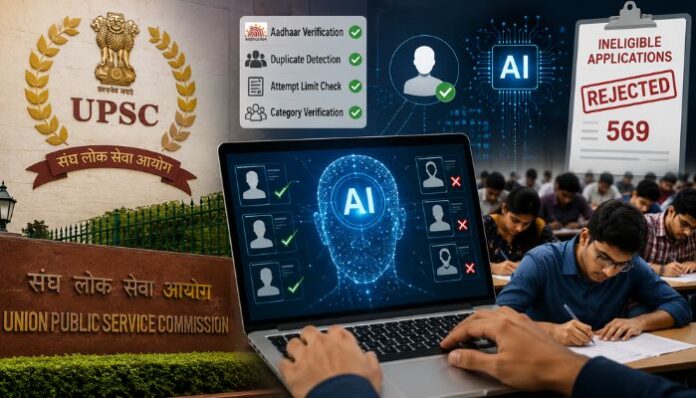
The Union Public Service Commission (UPSC) has, for the first time, used Artificial Intelligence (AI) at the application stage of the Civil Services Examination (CSE) to identify and remove ineligible candidates before the examination process moves forward. The exercise led to the rejection of 569 applications for the Civil Services Preliminary Examination 2026, including cases involving duplicate applications and candidates who had already exhausted the maximum number of attempts allowed under UPSC rules.
AI screening introduced after the Puja Khedkar controversy
The move comes nearly two years after the controversy involving former IAS trainee Puja Khedkar. In 2024, Khedkar was dismissed from service after it was found that she had appeared for the Civil Services Examination despite exhausting the permitted number of attempts by changing her name and her parents’ names. The UPSC later cancelled her candidature.
Until last year, such verification checks were generally conducted much later, usually during the interview stage, after candidates had already cleared both the preliminary and main examinations. This year, however, the commission decided to carry out the scrutiny much earlier.
According to UPSC rules, candidates from the general category are allowed six attempts up to the age of 32 years. OBC candidates can attempt the examination nine times until the age of 35, while SC and ST candidates are allowed unlimited attempts until the age of 37.
Aadhaar verification and AI-based checks
A total of 8.18 lakh candidates registered for the Civil Services Preliminary Examination held on 24th May 2026, while 5.49 lakh eventually appeared for the test. The number of applicants was lower than last year’s figure of 9.5 lakh.
Officials believe that one reason for the decline may be the new verification measures introduced this year. UPSC had launched a new application portal that offered Aadhaar-based authentication. Around 94% of applicants opted for Aadhaar verification, ensuring that they were unique candidates with no duplication.
For the remaining candidates, UPSC used AI-based tools to identify duplicate records by comparing names, parents’ names, dates of birth and photographs. The commission then matched these records with data from the last 15 years to determine whether candidates had crossed age limits or exhausted their permitted attempts.
This process identified 569 ineligible Civil Services applicants and another 69 candidates who had applied for the Indian Forest Service Examination.
Category changes were also verified
The commission also used AI to examine whether candidates had changed their social category from previous attempts. Around 43,497 applicants were found to have selected a different category than in earlier applications. UPSC contacted them through email for verification.
Officials said many candidates had previously applied under the general category because they could not obtain category certificates on time. However, 133 applications were ultimately cancelled after it was confirmed that the candidates had exceeded the number of attempts permitted for their respective categories.
Explaining the initiative, UPSC Chairman Ajay Kumar said, “Technology must serve the cause of fairness. This year, UPSC undertook a de-duplication exercise at the Prelims examination application stage to ensure that every genuine candidate is correctly identified and that fraudulent or multiple applications are detected and eliminated.”
He added, “UPSC strives to create a level playing field for every candidate, and technology is an important enabler in achieving that objective.”
