

On 3rd March (local time), President of the United States, Donald Trump, announced that Washington will provide political risk insurance and financial security guarantees for maritime trade passing through the Gulf region. The announcement came amid the escalating conflict in West Asia and growing fears of disruption to global oil supply.
"Effective IMMEDIATELY, I have ordered the United States Development Finance Corporation (DFC) to provide, at a very reasonable price, political risk insurance and guarantees for the Financial Security of ALL Maritime Trade… If necessary, the United States Navy will begin… pic.twitter.com/pIJyFwL78j
— The White House (@WhiteHouse) March 3, 2026
Trump’s announcement came after Iran threatened to attack ships attempting to cross the Strait of Hormuz, which is one of the world’s most critical chokepoints. Earlier, insurance companies gave notice to shipping companies that they would suspend insurance and increase premiums considering the Israel-US strikes on Iran which killed Supreme Leader Ali Khamenei after which Iran launched strikes on Tel Aviv and several Middle Eastern countries including UAE, Saudi Arabia and others.
DFC to insure maritime trade
In a post on Truth Social, Trump said he had directed the United States Development Finance Corporation (DFC) to immediately offer political risk insurance at a “very reasonable price” to shipping lines operating in the Gulf.
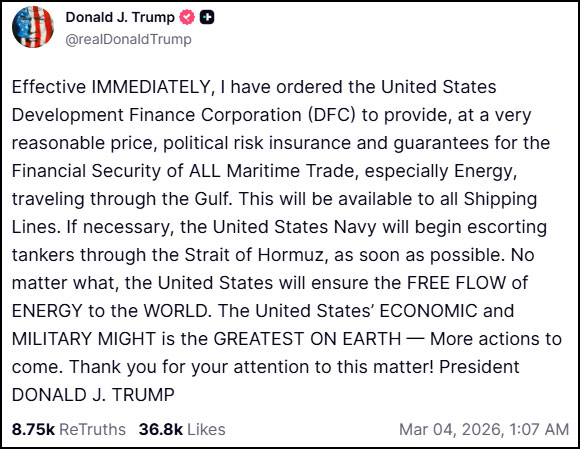
He wrote, “Effective immediately, I have ordered the United States Development Finance Corporation to provide political risk insurance and guarantees for the financial security of all maritime trade, especially energy travelling through the Gulf. This will be available to all shipping lines.”
Furthermore, he said that the US Navy could begin escorting tankers through the Strait of Hormuz if the situation deteriorates further. He added, “If necessary, the United States Navy will begin escorting tankers through the Strait of Hormuz as soon as possible. No matter what, the United States will ensure the free flow of energy to the world.”
Strait of Hormuz remains critical oil route
The Strait of Hormuz, which connects the Persian Gulf with the Gulf of Oman, handles nearly one fifth of the world’s oil shipments. The waterway has remained effectively closed for four days with threats from Iran and insurance companies imposing premium charges for the tankers passing through the Gulf region, especially through the Strait of Hormuz.
