

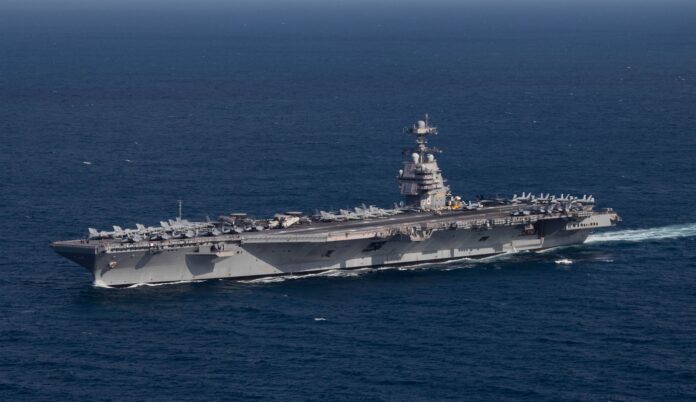
A fire broke out today in the main laundry spaces of the U.S. Navy’s flagship aircraft carrier USS Gerald R. Ford in the Red Sea, amidst the ongoing war against Iran. However, US Navy clarified that the fire was accidental and was not related to the war.
A post on X by the 5th U.S. Naval Forces Central Command/U.S. 5th Fleet said that the incident was quickly contained with no damage to critical systems, and the ship remained fully mission-capable. The blaze originated in the ship’s laundry facilities and was explicitly not combat-related, the Navy said.
Two sailors sustained non-life-threatening injuries and are in stable condition while receiving medical treatment. “Additional information will be provided when available,” the statement noted.
On March 12, USS Gerald R. Ford (CVN 78) experienced a fire that originated in the ship’s main laundry spaces. The cause of the fire was not combat-related and is contained.
— U.S. Naval Forces Central Command/U.S. 5th Fleet (@US5thFleet) March 12, 2026
There is no damage to the ship’s propulsion plant, and the aircraft carrier remains fully operational.…
The Gerald R. Ford Carrier Strike Group is currently operating in the Red Sea in direct support of Operation Epic Fury, the U.S. Central Command offensive launched on February 28, 2026, targeting Iranian missile sites, air defences, and other military infrastructure. The carrier has been conducting flight operations in the region as part of the largest U.S. military concentration in the Middle East in a generation.
No further details on the fire’s cause have been released, but the Navy emphasised that the propulsion plant and other vital systems were unaffected. The incident comes against a backdrop of recent maintenance challenges aboard the Ford, including ongoing issues with its vacuum-based sewage system that have drawn scrutiny during its extended deployment.
The Ford, the Navy’s newest and most advanced nuclear-powered supercarrier, entered the Red Sea earlier this month after transiting the Suez Canal. It continues to support combat operations despite the minor onboard incident. The U.S. Navy has a long history of dealing with shipboard fires, which are common hazards on vessels with complex machinery and high operational tempo.
