

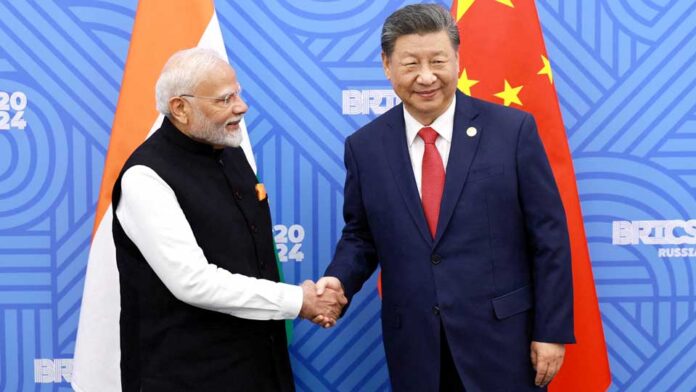
Chinese President Xi Jinping will travel to New Delhi this weekend to attend the 18th BRICS Summit, marking his first visit to India in nearly seven years and providing a major opportunity for the two Asian powers to deepen their ongoing efforts to repair relations strained by the 2020 border clash.
China officially confirmed Xi’s visit on Thursday. The official X account of China’s Ministry of Foreign Affairs spokesperson announced: “At the invitation of Prime Minister of the Republic of India Narendra Modi, President Xi Jinping will attend the 18th BRICS Summit in New Delhi from September 12 to 13.”
At the invitation of Prime Minister of the Republic of India Narendra Modi, President Xi Jinping will attend the 18th BRICS Summit in New Delhi from September 12 to 13. pic.twitter.com/abKPwOyqRm
— CHINA MFA Spokesperson 中国外交部发言人 (@MFA_China) September 10, 2026
The announcement formally puts Xi’s participation in the summit beyond speculation and sets the stage for a high-level meeting in New Delhi that is expected to attract considerable international attention.
Xi’s India visit will be his first since October 2019, when he travelled to India for an informal summit with Prime Minister Modi in Mamallapuram. Relations between the two countries subsequently suffered a severe setback after the deadly Galwan Valley clash in eastern Ladakh in June 2020 triggered a prolonged military stand-off along the Line of Actual Control.
The relationship has gradually shown signs of improvement in recent months, however, as New Delhi and Beijing have taken several steps aimed at restoring normal engagement. Direct flights between the two countries resumed last October, while border trade has also restarted. The two sides have continued diplomatic and military-level discussions over outstanding issues along their disputed frontier.
The latest development comes after boundary talks were held in Beijing in August. Chinese Foreign Minister Wang Yi subsequently described China and India as important neighbours and said that the development of bilateral ties served the interests of both countries as well as the wider Global South.
Xi’s presence at the BRICS summit will also place him alongside several other prominent leaders. Russian President Vladimir Putin, South African President Cyril Ramaphosa and Iranian President Masoud Pezeshkian are expected to attend the New Delhi meeting. Philippine President Ferdinand Marcos Jnr is also expected to participate.
For Xi, the India trip forms part of an exceptionally busy diplomatic schedule. Before arriving in New Delhi, the Chinese president travelled to Kyrgyzstan for the Shanghai Cooperation Organisation summit and then visited Egypt for a state visit. He is also expected to travel to Washington later this month for talks with US President Donald Trump.
The sequence of visits highlights the importance Beijing attaches to its engagement with major powers and emerging economies at a time of heightened geopolitical competition. Xi’s meeting with Modi will be particularly significant because China and India remain strategic competitors while simultaneously sharing substantial economic and geopolitical interests.
For New Delhi, the BRICS summit provides an opportunity to engage Xi directly on issues ranging from the border dispute and bilateral trade to regional security and cooperation among developing nations. While the resumption of flights, border trade and diplomatic dialogue indicates a cautious thaw, considerable mistrust remains between the two sides.
Xi’s return to India should therefore not be interpreted as an automatic resolution of the problems that have plagued bilateral relations since 2020. Instead, his presence in New Delhi represents a potentially important next step in a carefully managed rapprochement.
The fact that the Chinese president is returning to India after almost seven years, following an invitation from Modi, nevertheless carries considerable diplomatic significance. The September 12-13 BRICS summit could provide the two leaders with an important platform to consolidate the recent improvement in ties and determine whether the current thaw can evolve into a more stable and sustained relationship.
