

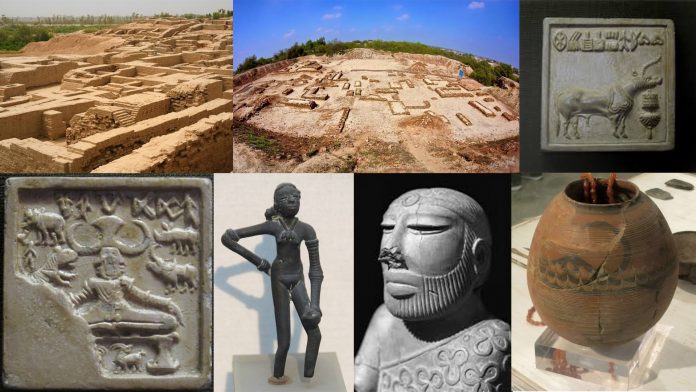
A research paper titled “Lipid residues in pottery from the Indus Civilisation in northwest India” published by the Journal of Archeological Science gives an insight into what the prehistoric people who lived during the Indus Valley Civilisation ate. As per the study, about 80% of the faunal assemblage (animal fossil) from various Indus sites belonged to domestic animal species, with cattle/buffaloes being the highest at almost 50-60%. Sheep and goats accounted to about 10% of animal remains.
The study suggests that the high percentage of cattle bones found suggest that there was a cultural preference for beef across Indus Valley Civilisation which was supplemented by mutton/lamb. Pigs make up about 2–3% of total faunal assemblages across Indus sites as per the research. Further, remains of wild animals like deer, antelope, gazelle, hares, birds, and riverine/marine resources are also found in small proportions at these sites.
For the study, as many as 172 pottery fragments which were recovered from the sites were analysed. These fragments were recovered from 7 rural and urban settlements located in northwest India. Various fats and oils which were absorbed into the ancient ceramic vessels during their use were extracted and identified.
The scientists believe the findings highlight the resilience of rural settlements in northwest India during the transformation of the Indus Civilisation, and during a period of increasing aridity. In conclusion, despite the limitations, this study constitutes an important starting point which could broaden our thinking about Indus Valley Civilisation.
“The results demonstrate that the use of organic residue analysis in South Asia, combined with other bioarchaeological approaches, will facilitate a new understanding into the enormous diversity of prehistoric South Asian foodways and the relationship between pottery and foodstuff over time,” the study concludes.
You could read the study in detail here.


