

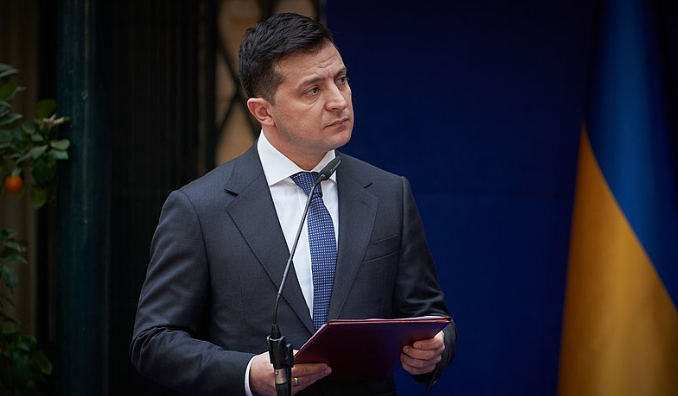
Ukraine’s President Zelenskyy has invited the ire of several Israeli lawmakers for his comments on the Holocaust. Addressing the Knesset (Israel’s legislative body), Zelenskyy drew comparisons between the Russian invasion of Ukraine and the Holocaust, infuriating several lawmakers in the Knesset.
In a video conference, Zelenskyy asked Israel to join the western economic sanctions against Russia, and to provide weapons to Ukraine. During his speech, Zelenskyy claimed that Russian President Vladimir Putin is attempting to carry out a “final solution” in his country, evoking the deliberate, planned mass murder of Europe’s Jews by the Nazis.
“You remember it and will never forget it for sure,” he said. “But you should hear what is coming from Moscow now. They are saying the same words now: ‘final solution.’ But this time it’s about us, about the Ukrainian question”, he said, as per the associated press.
However, the Ukrainian President’s plea didn’t go down well with everybody with several lawmakers criticizing Zelenskyy for drawing comparisons between the Holocaust and Russia’s invasion of Ukraine, and ignoring some Ukrainians’ complicity in the Nazi-led genocide.
Israel’s Communications Minister Yoaz Hendel tweeted ,”I appreciate the President of Ukraine and support the Ukrainian people in heart and deed, but it is impossible to rewrite the terrible history of the Holocaust. Genocide also committed on Ukrainian soil. The war is terrible but the comparison to the horrors of the Holocaust and the final solution is outrageous.”
מעריך את נשיא אוקראינה ותומך בעם האוקראיני בלב ובמעשה, אבל אי אפשר לשכתב את ההיסטוריה הנוראה של השואה.
— Yoaz Hendel יועז הנדל (@YoazHendel1) March 20, 2022
רצח עם שבוצע גם באדמת אוקראינה. המלחמה נוראה אבל ההשוואה לזוועת השואה והפתרון הסופי מקוממת.
Opposition Likud’s member of Knesset (MK) Yuval Steinitz said that Ukraine President’s comments border on Holocaust denial. He further added ,”The same is true for the claim that Ukrainians helped Jews in the Holocaust. The historic truth is that the Ukrainian people cannot be proud of its behavior during the Holocaust towards the Jews.”
Another Likud MK Yoav Kisch tweeted ,”War is bad, difficult, and creates unnecessary victims and bloodshed. It is not a holocaust. A holocaust is, among other things, intentional genocide, ovens, gas chambers, mass graves and the premeditated murder of women and children. The only word to describe the Holocaust is holocaust. A holocaust is not war.”
מלחמה זה רע וקשה וגוררת קורבנות ומחיר דמים מיותר.
— יואב קיש Yoav Kisch (@YoavKisch) March 20, 2022
שואה זה לא.
שואה זה בין השאר רצח עם מכוון, זה משרפות, זה תאי גזים, זה קברים המוניים, רצח נשים וילדים בכוונה תחילה.
לשואה אין מילה אחרת חוץ משואה.
שואה היא לא מלחמה.
Zelenskyy’s speech was also called out by several journalists for his attempts at historical revisionism with people reminding Ukraine’s President about Ukraine’s role in the Holocaust.
Zelensky’s claim that the Ukrainians were righteous gentiles who saved Jews in the Holocaust is sick historical revisionism. The Ukrainians were active, enthusiastic Nazis. Ukrainian Jewry wasn’t annihilated in Poland, but in Ukraine, by their neighbors.
— Caroline Glick (@CarolineGlick) March 20, 2022
Zelensky just gave an address to the Knesset in which he demanded Israeli support, likening his situation to the Holocaust, and proceeded to claim that Ukraine was a safe haven to Jews during the Holocaust. An incredible level of gaslighting.
— Jordan Schachtel @ dossier.substack.com (@JordanSchachtel) March 20, 2022
President Zelenskyy, who is himself a Jew, has also lost members of his family during the Holocaust when vast majority of Ukrainian Jews were killed, among others around Europe.


