

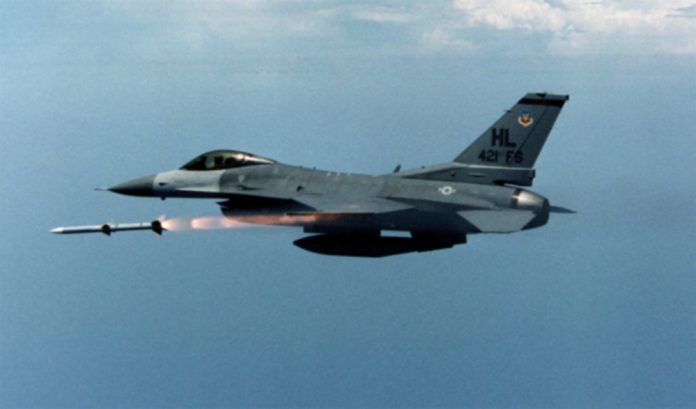
The United States has denied reports claiming it approved the sale of new Advanced Medium-Range Air-to-Air Missiles (AMRAAMs) to Pakistan. In a statement, the US Embassy in India called such media reports “false”, making it clear that no new missiles are being supplied to Islamabad. The embassy explained that a recent contract amendment mentioned in the reports only covers sustainment and spare parts for existing systems, not any new weapon deliveries.
“Contrary to false media reports, no part of this referenced contract modification is for deliveries of new AMRAAMs to Pakistan,” the embassy said, adding that the agreement “does not include any capability upgrade” for the country’s arsenal.
The clarification came after several media outlets suggested that the US Department of War’s latest contract modification could involve the transfer of new missiles to Pakistan. These reports had sparked speculation that Washington might be offering Islamabad a defence boost amid improving ties between the two countries.
Quoting a press release by the United States Department of War (DoW), formerly known as the Department of Defence, the reports claimed that the deal was the result of improving US-Pakistan ties under Donald Trump. EurAsia Times even claimed that US has approved the sale of the “MiG-21 Killer” AMRAAM Missiles To Pakistan, asking whether it is another hint to India. The media reports also speculated that US was upgrading Pakistani Air Force’s F-16 fleet. Notably, only the F-16 jet in PAF fleet can carry the AMRAAM missile, other planes including the Chinese jets used by Pakistan are not compatible.
The issue took a political turn in India, with the Congress party on October 8 targeting the Narendra Modi government accusing it of lossing US alliance to Pakistan. Congress leader Jairam Ramesh said the development showed how quickly “diplomatic setbacks accumulate.”
Posting on X, Ramesh cited two public notifications from the US Department of War one from May 7, 2025, which listed countries such as Canada, Taiwan, Poland, Sweden, and Japan as recipients of Raytheon’s AIM-120 missiles, and another from September 30, 2025, which expanded the list to include Pakistan, along with Qatar, Oman, Saudi Arabia, Israel, and Turkey.
“How quickly the diplomatic climate changes, and how quickly diplomatic setbacks accumulate!” Ramesh wrote, sharing both documents online. The Congress said the development “raises serious questions” about India’s foreign policy and its weakening diplomatic leverage under the Modi government, demanding that the Centre clarify how such reports gained ground and what steps are being taken to safeguard national interests.
US denies the supply of newly produced Advanced Medium-Range Air-to-Air Missiles (AMRAAMs) to Pakistan.
— All India Radio News (@airnewsalerts) October 10, 2025
In a clarifying statement, US Embassy in India asserted that a recent amendment to an American Foreign Military Sales contract amendment is not a transfer of new weapon… pic.twitter.com/2VrFrWtqH6
However, the embassy firmly rejected those claims, stressing that the contract is “sustainment in nature”, meaning it is only meant for maintenance and support of existing equipment.
The USD 41.7 million contract was awarded to Raytheon Missiles & Defense, the manufacturer of AMRAAMs. It is part of a much larger USD 2.5 billion agreement under the Foreign Military Sales (FMS) program involving over 30 allied countries, including the UK, Germany, Israel, Australia, Qatar, Japan, Saudi Arabia, Turkiye, and Pakistan. The work is expected to continue until May 2030.
While Pakistan’s name appeared in the list of participating countries, the US clarified that its inclusion is only for spare parts and sustainment activities, not new missile deliveries. The clarification also comes at a sensitive time, following Operation Sindoor, when Indian and Pakistani forces were reportedly engaged in aerial combat. Reports of a potential missile supply had raised concerns about a possible shift in regional air power.
Pakistan had earlier purchased around 700 AMRAAMs in 2007 for its F-16 fighter jets, one of the largest international orders for the missile system at that time. Recent speculation grew after Pakistan’s Prime Minister Shehbaz Sharif and Army Chief General Asim Munir met former US President Donald Trump in Washington last month.
