

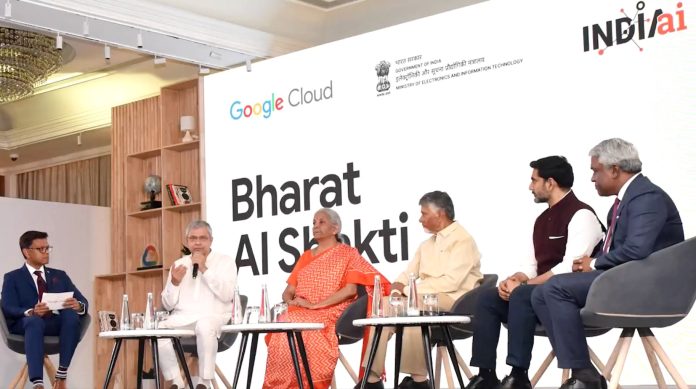
In a bold bid to redefine India’s role in the global digital landscape, Union Minister for Electronics and Information Technology Ashwini Vaishnaw has proposed to position the Andaman and Nicobar Islands into a major hub for international internet data transfer. Unveiled at Google’s Bharat AI Shakti event today, the initiative capitalizes on the archipelago’s prime Bay of Bengal location to ease strains on saturated hubs like Singapore, opening pathways for enhanced connectivity to Southeast Asia, Australia, and beyond.
The proposal was made amid Google’s announcement of a landmark USD 15 billion investment over the next five years (2026–2030) to establish its largest AI hub outside the United States in Visakhapatnam, Andhra Pradesh, the company’s biggest commitment to India to date.
Speaking at the event, which also featured Andhra Pradesh Chief Minister N. Chandrababu Naidu and Google Cloud CEO Thomas Kurian, Vaishnaw underscored the transformative potential of these developments of the archipelago. “The Andaman and Nicobar Islands are strategically located. Singapore is already overburdened. Why can’t we make Andaman the next major hub for global internet data transfer? From the Government of India’s perspective, we will provide full support for this initiative. The Andaman Islands can help Google and other internet-based organizations connect to Southeast Asia, Australia, and other regions that are seeking new data capacity.”
Google’s new Gigawatt-scale AI hub in Bharat ??
— Ashwini Vaishnaw (@AshwiniVaishnaw) October 14, 2025
✅ It will accelerate large-scale upskilling & reskilling of IT professionals. pic.twitter.com/J7NBJiO2TI
Vaishnaw’s vision extends to bolstering Northeast India’s digital infrastructure through a proposed submarine cable link from Visakhapatnam to Sittwe in Myanmar. This Vizag-Sittwe corridor would integrate with the RailTel network and ongoing railway extensions to the Myanmar border, already advanced up to Sairang in Mizoram, with further progress dramatically improving high-speed access in remote states like Mizoram.
He highlighted the role of new international subsea gateways in Visakhapatnam, tying into Google’s expansive network of over two million miles of cables, to foster route diversity alongside existing landings in Mumbai and Chennai.
The Visakhapatnam AI Hub, developed in partnership with AdaniConneX and Airtel, will feature a gigawatt-scale data center campus equipped with cutting-edge AI infrastructure, expanded fibre-optic networks, transmission lines, clean energy generation, and storage systems.
It aims to power Google services like Search, Workspace, and YouTube while supporting enterprises such as MakeMyTrip, Meesho, TCS, and startups including CoRover, Glance, Invideo AI, and Sarvam. Kurian described the project as a “landmark investment in India’s digital future,” emphasizing its capacity to “deliver industry-leading AI infrastructure at scale” for faster innovation and inclusive growth, in line with commitments from the Indian and U.S. governments to deploy AI responsibly.
Minister Vaishnaw hailed the hub as a “game-changer” for India’s digital economy, praising its AI-first architecture, subsea cable integrations, and clean energy focus. “This infrastructure breaks new ground… It will not only fuel a new era of AI-driven services but also create high-value jobs and economic opportunities across the country,” he noted, linking it directly to the India AI Mission’s goals.
The minister urged Google to prioritize reskilling IT professionals and welcomed its Tensor Processing Units (TPUs) to “compete with Nvidia’s GPUs” in the mission’s shared compute ecosystem, positioning AI services as a vital engine for youth employment.
CM Naidu celebrated the investment as a “new chapter in India’s digital transformation,” positioning Visakhapatnam as a beacon for AI adoption and startup support in Andhra Pradesh.
The hub’s renewable energy emphasis aligns with Google’s net-zero ambitions by 2030 and enhances grid resilience, while accelerating the deployment of Google’s full AI stack for low-latency services in business, research, and development. This convergence of geography, policy, and private capital resonates with Prime Minister Modi’s Viksit Bharat 2047 vision, advancing Digital India by bridging urban-rural divides and cementing India’s status as an AI powerhouse.
