

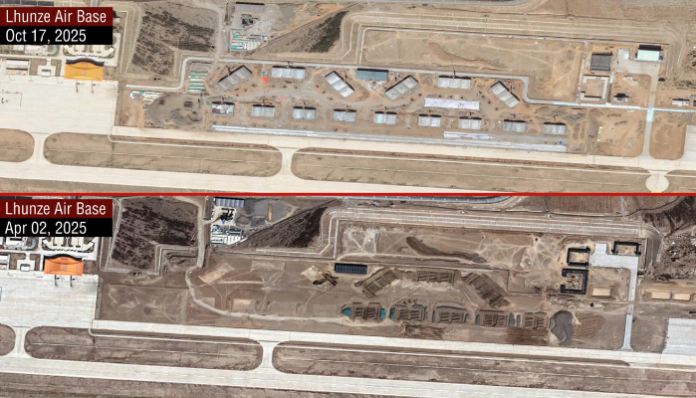
China’s Lhunze airbase in Tibet now boasts 36 hardened aircraft shelters, new administrative blocks and a new apron, reported NDTV. It is located around 40 kilometres north of the McMahon line which marks the border between India and China in the Arunachal Pradesh region. China can now deploy fighter aircraft and a variety of drone systems from its arsenal owing to the new hardened shelters at Lhunze.
The place is approximately 107 kilometres from the strategically important town of Tawang in Arunachal Pradesh. It also reduces the time required for the Indian Air Force to react to any airborne threat originating from its own airbases in Arunachal Pradesh and Assam.
Air Chief Marshal BS Dhanoa (retired), the former Indian Air Force chief expressed, “Construction of 36 hardened aircraft shelters at Lhunze clearly indicates that during the next incident, their tactical fighters and attack helicopters operating in support of their army would be based in Lhunze.” He added that the underground tunnels would have already been stocked with fuel and ammo.
According to former Indian Air Force vice chief Air Marshal Anil Khosla, the reinforced shelters make it “far more challenging to degrade the base early in a conflict” by providing protection from missile barrages, Indian airstrikes and precision-guided missiles.
“Air Bases like Tingri, Lhunze, and Burang are located close to the Line of Actual Control (LAC), within 50-150 km. This proximity allows for the quick deployment of PLA Air Force assets to forward positions and shorter response times in case of a border escalation. These airfields enable coverage of Indian positions in Arunachal Pradesh, Sikkim, Uttarakhand, and Ladakh,” he remarked.
There are also a few CH-4 drones seen on the tarmac at Lhunze, according to the latest photos from Vantor (previously Maxar). The CH-4 Unmanned Aerial Vehicle is an useful attack platform that can be employed in the Tibet region. It is built for high-altitude missions and can fire short-range air-to-surface missiles from altitudes higher than sixteen thousand feet. The CH-4 drone, which has an electro-optical sensor turret, is controlled by its ground operators via a datalink.
The first Sky Guardian drones produced by General Atomics will be deployed by the Indian Army and Air Force in 2029. Each of the two forces will receive eight drones. The Sky Guardian, a Sea Guardian derivative, is part of a $3.5 billion contract in which the Indian Navy is purchasing 15 of them.
With the added capability of conducting precision strike missions, these US-built drones will play a crucial role in improving India’s information, surveillance and reconnaissance (ISR) capabilities throughout the Himalayas. The Indian military now has Heron and Searcher UAVs, which are made in Israel.
The rapid construction of these aircraft shelters across from India’s Tawang sector, according to geointelligence specialist Damien Symon, demonstrates Beijing’s attempt to increase its air strength in a historically sensitive area. China is currently upgrading six new air bases along the Himalayan border, including the Lhunze facility. These stations are situated in close proximity to India’s defences.
Air bases also include new apron area, engine test pads, and support structures, along with hangars and runway extensions. India’s long-standing advantage along the Himalayas is being challenged by China’s ongoing modernisation of its current air facilities and development ofnew ones. From Leh in the north to Chabua in the east, the IAF has run 15 significant air bases for many years.
Despite efforts to restore relations between Beijing and New Delhi following the Galwan standoff between Indian and Chinese forces, the ongoing air base renovations indicate a new, altered strategic reality in the region.
