

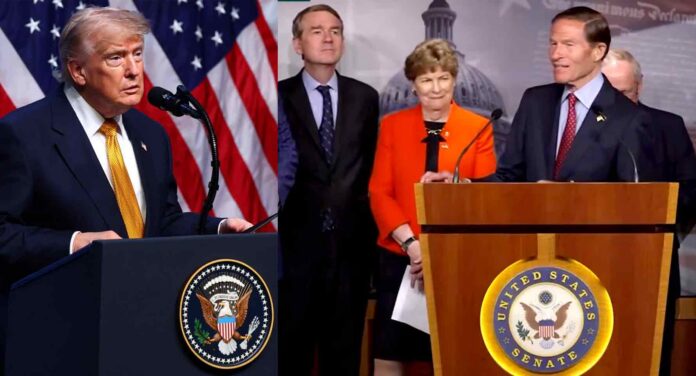
While the US Supreme Court struck down Trump’s reciprocal tariffs, and an additional 25% tariff on India for buying Russian oil was withdrawn earlier this year, the threat of a US tariff on Indian exports to the USA has returned. In a significant bipartisan push to intensify pressure on Russia amid its ongoing conflict with Ukraine, a group of US senators has unveiled an updated sanctions bill that would impose up to 100 per cent tariffs on major importers of Russian oil, including India and China.
The legislation, known as the Sanctioning Russia Act, comes as a tribute to the late Republican Senator Lindsey Graham, who had been a vocal advocate for tougher measures against Moscow before his sudden demise earlier this week. Senator Graham, along with Democratic Senator Richard Blumenthal, had worked on the package for nearly two years, securing backing from the Trump administration just days prior to his passing.
The updated bill, backed by both Republican and Democratic senators, marks a moderation from Graham’s original proposal, which had called for tariffs as high as 500 per cent on countries continuing to purchase Russian energy. Instead, the revised version targets the top five importers of Russian crude oil and Russian natural gas.
The top five purchasers of Russian crude oil are China, India, Slovakia, Hungary and Azerbaijan, while the top importers of Russian natural gas are China, France, Japan, Hungary and Belgium.
However, the bill exempts countries that import less than 15% of Russia’s natural gas exports and that are taking significant steps to reduce those imports. 15 European nations that buy gas from Russia have been exempted from the tariffs.
According to details shared in congressional briefings, the bill also includes visa bans, asset freezes, and sanctions on Russian officials, banks, and energy firms. The bill also imposes sanctions on Russia’s shadow fleet of tankers that do not depend on Western maritime services, on Russian financial institutions, including the Central Bank of the Russian Federation, and on Russia’s largest state-owned energy projects, including Yamal LNG and Arctic LNG 1, 2 and 3.
It aims to disrupt Moscow’s war economy by penalising nations that help sustain it through oil and gas purchases, while providing the US President with tools to enforce these measures if Russia does not engage seriously in peace talks.
Supporters argue that the legislation honours Graham’s legacy and sends a strong message to countries continuing trade with Russia. “We owe it to Lindsey Graham to pass that tough Russian sanctions bill,” said one lawmaker, reflecting the cross-party momentum. However, critics have cautioned that such broad tariffs could complicate global energy markets and diplomatic efforts, potentially raising costs for consumers worldwide without necessarily altering Russia’s behaviour.
The bill enjoys substantial support, with over 80 Senate co-sponsors, and is expected to advance quickly towards a vote. For India, which has significantly increased its imports of discounted Russian crude since the start of the Ukraine conflict to bolster energy security, the proposed tariffs could pose challenges to bilateral trade relations with the United States if enacted.
If the bill is passed, this will be the first time that Congress will explicitly authorise the president to use tariffs as a geopolitical weapon to target Russia and buyers of Russian energy.
