

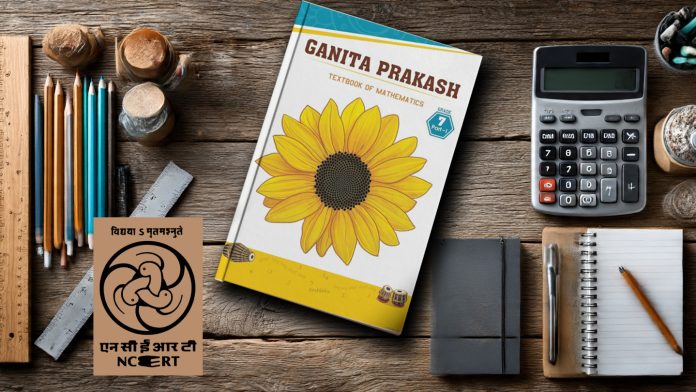
The second part of the Class 7 mathematics textbook “Ganita Prakash,” by the National Council of Educational Research and Training (NCERT) has been recently released. Notably, the fresh edition highlights the contributions made by ancient Indian mathematicians to algebra, integers and geometry. The policy in line with the National Education Policy 2020 which aims to incorporate Indian Knowledge Systems into curricula.
The books include multiple references to India’s long-standing contributions to the subject and add that the country’s mathematicians were the first to invent many important concepts in mathematics. They outline an ancient Indian treatise on geometry, provides instances from Sanskrit sources and presents questions alongside solutions pertaining to the work of ancient Indian mathematicians.
The ancient Indian idea of “Bijaganita” which is now known as “algebra” is mentioned in the textbook’s chapter on algebraic equations. It mentions Brahmasphutasiddhanta, a treatise written by Brahmagupta in the seventh century CE as the first known source that outlines guidelines for “multiplication and division of positive and negative numbers were articulated.”
This is referred to as a crucial stage in the development of algebra and arithmetic. Brahmagupta’s rules for employing positive and negative integers together with a math problem pertaining to them is introduced next. According to the textbooks, some of the oldest known works in algebra have been produced by Indians.
A chapter states, “forming expressions using symbols and solving equations with such expressions was an important component of mathematical explorations in ancient India,” on “Bijaganita” regarding algebraic equation. India’s foundational influence in algebra is demonstrated by the work on adding, subtracting and multiplying unknown numbers employing letters.
The book also describes how the Arabic mathematician Al-Khwarizmi, whose work subsequently spread to Europe via Latin translation and was the force behind the modern word “algebra” was impacted by Indian mathematical ideas.
“In the 8th century, Indian mathematical ideas were translated into Arabic. They influenced a well-known mathematician named Al-Khwarizmi, who lived in present-day Iraq. Around 825 CE, he wrote a book called Hisab al-jabr wal-muqabala, which means calculation by restoring and balancing,” the textbooks inform and further convey, “The word al-jabr from his book gave us the word algebra, which we also still use today.”
Furthermore, it comprises a collection of symbols used to represent unknowns by ancient Indian mathematicians from Brahmagupta’s time, as well as an example of a math problem from Bhaskaracharya’s “Bijaganita” which is a treatise from the 12th century.
Likewise, ancient Indian geometry is discussed in “Constructions and Tilings.” It discusses the way the Sulba-Sutras utilised ropes to create perpendicular bisectors for ritual fire altars. This illustrates India’s superior understanding of geometric constructs in comparison to other civilisations of the same era.
It mentions, “Ancient mathematicians from different civilisations, including India, knew exact procedures to construct perpendiculars and perpendicular bisectors. In India, the earliest known texts containing these methods are the Sulba-Sutras. These are ancient geometric texts dealing with the construction of fire altars for rituals.”
According to NCERT Director Dinesh Prasad Saklani, teaching kids accurate history without a distorted colonial perspective is one of the goals of introducing these concepts. The enormous Indian contribution to mathematics was further emphasised by Dhruv Raina, a historian, philosopher of science and former professor at Jawaharlal Nehru University (JNU).
“The Arabs were profoundly influenced by the work of Indian mathematicians, particularly Brahmagupta. They improvised upon these methods to create what we consider algebra today. The Arab mathematicians were great synthesisers and innovators with the knowledge they acquired from ancient Greek, Indian and Chinese traditions,” he expressed, according to a report in The Indian Express.
“The purpose is threefold. One, to teach students correct history. For too long, the history of mathematics has been presented in India from a colonial European perspective, giving a skewed view. This can only be fixed through presenting history correctly and accurately. Two, to make the subject more interdisciplinary and thereby improve learning. Three, to develop a sense of pride and inspiration in students,” Saklani asserted while talking about the intention behind the move.
There was no mention of ancient Indian mathematicians in the old Class 7 textbooks. New school textbooks in accordance with the National Curriculum Framework and the National Education Policy (NEP) 2020 have been released by NCERT. The NEP mandates that “Indian Knowledge Systems” should be incorporated in the curriculum. India’s mathematical legacy was also addressed in the first part of the textbooks which were published earlier this year.
