

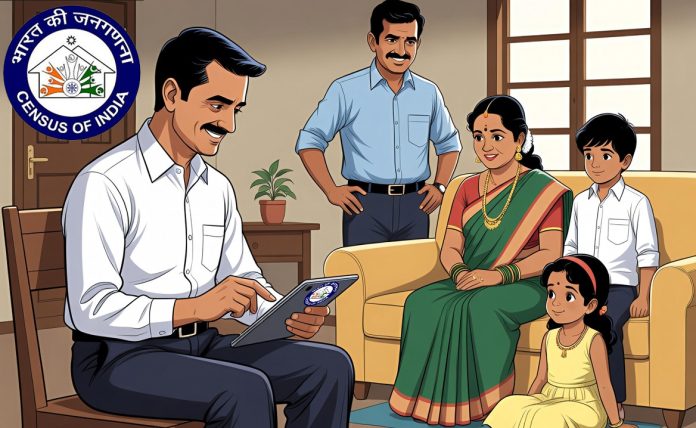
The Union Cabinet chaired by Prime Minister Narendra Modi on Friday approved the comprehensive scheme for conducting the Census of India 2027. The cabinet has approved ₹11,718.24 crore to conduct the census, which is being done after the last census in 2011, as the decadal census in 2021 could not be held due to the COVID-19 pandemic
The exercise marks the 16th national census and the eighth since independence, which will provide updated information about India’s population and demography.
The census will be held two phases, the Houselisting and Housing Census will take place from April to September 2026, after that the Population Enumeration will take place in February 2027. Special provisions have been made for high-altitude and snow-bound regions, including the Union Territory of Ladakh and parts of Jammu & Kashmir, Himachal Pradesh, and Uttarakhand, where enumeration will commence earlier in September 2026.
This initiative will involve a massive mobilization of human resources, with approximately 30 lakh field functionaries, including enumerators, supervisors, master trainers, charge officers, and principal/district census officers, set to fan out across the country. Primarily government school teachers appointed by state governments, these enumerators will visit every household, filling detailed questionnaires on housing, amenities, demographics, religion, Scheduled Castes and Tribes, language, literacy, education, economic activity, migration, and fertility. Additional support staff at sub-district, district, and state levels will be deputed by respective administrations, with all personnel receiving honorariums for their efforts.
A standout feature of the 2027 census is its fully digital transformation, positioning India at the forefront of global data collection practices. The process will involve use of mobile applications for collection of real-time data, and the use of a Central portal for monitoring the process. The mobile app will be available on both Android and iOS. in capture.
The Census Management & Monitoring System (CMMS) portal will facilitate seamless oversight, while the Houselisting Block (HLB) Creator, a web-based mapping tool, will empower charge officers to delineate operational boundaries efficiently.
Citizens will also have the option for self-enumeration through secure digital interfaces, complete with robust cybersecurity measures to safeguard sensitive information.
“Suitable security features have been provisioned for this mammoth digital operation,” the cabinet said.
In a significant policy inclusion, the cabinet has incorporated caste enumeration as an electronic module within the Population Enumeration phase. This has been done as per the decision ratified by the Cabinet Committee on Political Affairs on April 30, 2025. “With the huge social and demographic diversity in our country and related challenges, the Census 2027 will also capture Caste data electronically in second phase, i.e. Population Enumeration (PE),” the statement issued by the cabinet said.
Digitisation will ensure the completion of the census in shortest possible time. The govt will also make efforts to publish the Census Results with more customized visualization tools. Data will be shared with all, up to the lowest Administrative Unit i.e. Village/Ward level.
The census will also introduce “Census-as-a-Service” (CaaS), a user-friendly platform delivering clean, machine-readable datasets to ministries and stakeholders. Advanced dissemination tools will allow instant queries and customizable reports, accelerating policy formulation in areas like welfare, urban planning, and resource allocation.
An estimated 18,600 technical personnel will be engaged in the process for 550 days, generating over 1.02 crore man-days of work. The provision of technical manpower at Charge/ District/ State level will also result in capacity building as the nature of job will be related to digital data handling, monitoring and coordination. This will also help in future employment prospects of these persons.
A nationwide publicity campaign is also in the works to raise awareness and encourage public participation, emphasizing the census’s role in shaping equitable development.
