

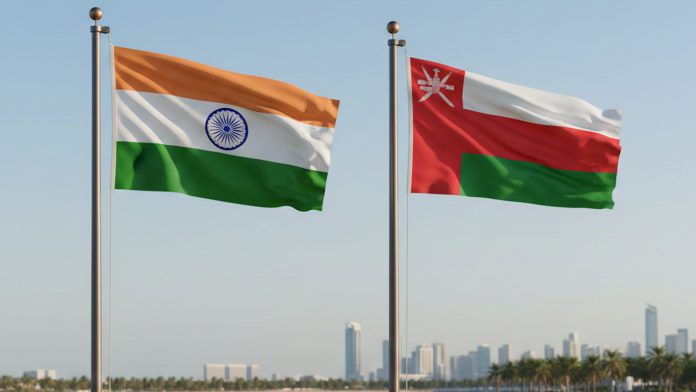
India is poised to take a significant step in its Gulf outreach with the impending signing of a Comprehensive Economic Partnership Agreement (CEPA) with Oman. More than a routine trade pact, the agreement reflects New Delhi’s broader strategy of embedding itself deeper into regional value chains, strengthening supply resilience, and building durable economic partnerships at a time of global realignment.
For Oman, the agreement carries equal weight. It will be only the second free trade agreement Muscat has signed with an individual country, and the first such pact in nearly two decades. The timing underscores Oman’s intent to diversify its economy, expand non-oil trade, and attract long-term investment partnerships, with India emerging as a natural and trusted partner.
A trade strategy coming into its own
The India–Oman CEPA fits into a larger mosaic of trade agreements that India has concluded in recent years, many of which are already delivering tangible outcomes for farmers, exporters, and manufacturers. The Comprehensive Economic and Trade Agreement (CETA) with the United Kingdom in 2025 has sharply reduced tariffs on over 90 per cent of traded goods, setting the stage for a substantial expansion in bilateral commerce.
Earlier, India’s 2024 trade and economic partnership with the EFTA bloc, comprising Switzerland, Norway, Iceland, and Liechtenstein, stood out not only for market access but also for strong investment commitments into India. Agreements with Australia and the UAE in 2022 opened new doors for Indian goods ranging from textiles and gems to engineering products, while the 2021 pact with Mauritius positioned the island nation as India’s gateway to Africa.
Taken together, these agreements highlight a clear policy direction: diversification over dependence, resilience over vulnerability, and mutual growth over transactional trade.
India–Oman trade shows sustained momentum
India’s economic engagement with Oman has followed a similar upward trajectory. Over the past eight years, bilateral trade has risen from USD 6.70 billion in 2017–18 to USD 10.61 billion in 2024–25, reflecting steady expansion across sectors. The current financial year has maintained this momentum, with trade touching USD 5.45 billion between April and September 2025–26 alone.
The numbers also tell a story of diversification. Oman is now India’s 28th largest trading partner, while India ranks as Oman’s fourth largest source of non-oil imports and its third largest destination for non-oil exports. This shift beyond hydrocarbons signals a maturing economic relationship anchored in complementary strengths.
Complementary trade structures
The composition of trade between the two countries reflects this synergy. India’s exports to Oman include refined petroleum products, aluminium oxide, rice, machinery, boilers, electrical equipment, plastics, iron and steel, ceramics, cosmetics, and even aircraft components.
Oman, in turn, plays a critical role in India’s energy and industrial supply chain. Crude oil and liquefied natural gas dominate Indian imports, supplemented by fertilisers, organic chemicals, sulphur, ammonia, iron ore, plastics, and aviation-related components. This balance highlights Oman’s importance not just as an energy supplier, but as a source of essential industrial inputs.
Investment ties run deep
Beyond trade, investment linkages form a strong backbone of the relationship. More than 6,000 India–Oman joint ventures are currently operational in Oman, collectively estimated to have contributed around USD 7.5 billion to the Omani economy through sustained capital investment across sectors.
Oman’s confidence in India is equally visible in investment flows. Between April 2000 and March 2025, cumulative FDI equity inflows from Oman into India stood at over USD 605 million, reflecting long-term strategic interest rather than short-term capital movement.
OIJIF and flagship partnerships
Institutional mechanisms have played a decisive role in deepening this cooperation. The Oman–India Joint Investment Fund (OIJIF), established in 2010 as a 50:50 partnership between the State Bank of India and the Oman Investment Authority, has already invested USD 320 million across two tranches in Indian projects. A third tranche of USD 300 million, announced during Sultan Haitham bin Tarik’s visit to India in December 2023, is now under implementation, further reinforcing investor confidence.
Equally emblematic is the Oman India Fertiliser Company (OMIFCO) at Sur, a USD 969 million joint venture operational since 2006. As a partnership between Oman Oil Company and Indian cooperatives IFFCO and KRIBHCO, OMIFCO has become a cornerstone of India’s fertiliser security while strengthening Oman’s industrial ecosystem.
Indian industry expands its footprint
Indian companies are steadily increasing their presence in Oman through joint ventures and investments in Special Economic Zones. Their footprint now spans both traditional sectors such as oil and gas, construction, logistics, and manufacturing, and emerging areas including green hydrogen, green ammonia, green steel, renewable energy, waste management, software solutions, finance, and communications.
This expansion aligns closely with Oman’s Vision 2040 and India’s own emphasis on sustainability and advanced manufacturing.
The proposed India–Oman CEPA is not merely about lowering tariffs; it is about locking in a long-term strategic alignment. With trade volumes rising, investment frameworks deepening, and cooperation expanding into green and future-oriented industries, India–Oman economic relations are entering a more mature and resilient phase.
As both countries look beyond hydrocarbons towards diversification and sustainability, the partnership is well-positioned to emerge as a model of mutually beneficial Gulf–India economic engagement in the years ahead.
