

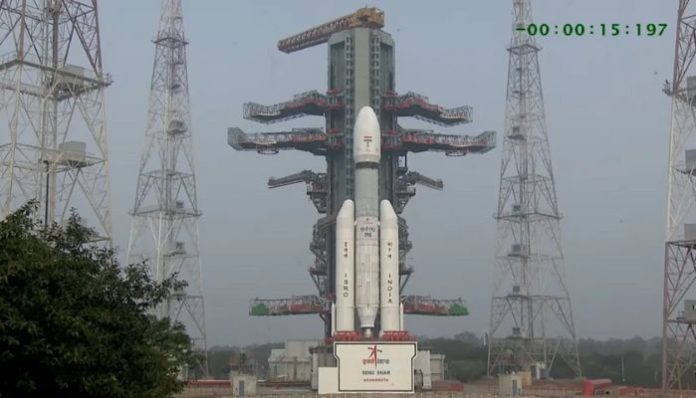
The Indian Space Research Organisation (ISRO) successfully launched the LVM3-M6 spacecraft on Wednesday, 24th December, which carries the United States’ next-generation BlueBird Block-2 communications satellite into Low Earth Orbit (LEO). Weighing 6,100 kg, the satellite is the largest to be launched by the LVM3 rocket into LEO, thus setting yet another record for the heavy-lift launch vehicle of India.
ISRO also stated that the operation was successfully carried out from the Satish Dhawan Space Centre located in Sriharikota, Andhra Pradesh. The LVM3 launch vehicle, also known as GSLV Mk III, is 43.5 meters tall. The GSLV Mk III is India’s strongest launch vehicle. The rocket is comprised of three stages with a cryogenic upper stage. This was developed by the Liquid Propulsion Systems Centre at ISRO.
VIDEO | ISRO's LVM3-M6 lifts off with BlueBird Block-2 satellite from Satish Dhawan Space Centre (SDSC) SHAR, Sriharikota. The satellite is part of a next generation of BlueBird Block-2 communication satellites, designed to provide space-based cellular broadband connectivity… pic.twitter.com/MRXpCOhvBV
— Press Trust of India (@PTI_News) December 24, 2025
For lift-off, the rocket used two massive S200 solid strap-on boosters that provided the enormous thrust required to carry the heavy satellite. These boosters were developed by the Vikram Sarabhai Space Centre in Thiruvananthapuram.
The mission was undertaken under a commercial agreement between NewSpace India Limited (NSIL), ISRO’s commercial arm, and US-based company AST SpaceMobile. The BlueBird Block-2 satellite is part of AST SpaceMobile’s ambitious plan to build a space-based cellular broadband network that can directly connect to regular smartphones without any special equipment.
Liftoff!#LVM3M6 launches the BlueBird Block-2 spacecraft from SDSC SHAR.
— ISRO (@isro) December 24, 2025
Youtube Livestreaming link:https://t.co/FMYCs31L3j
For More information Visit:https://t.co/PBYwLU4Ogy
#LVM3M6 #BlueBirdBlock2 #ISRO #NSIL
What BlueBird Block-2 aims to achieve
According to ISRO, the BlueBird Block 2 satellite aims to provide high-speed mobile connectivity all over the world. The satellite can support 4G and 5G networks, along with voice communications, video calls, messaging, data transfer, and media streaming.
The satellite is a part of a larger constellation of satellites in Low Earth Orbit, which is being developed by AST SpaceMobile. The satellite comes equipped with a gigantic 223 square meter phased array antenna; this makes it the largest communications satellite in LEO at an orbital height of around 600 kilometres.
AST SpaceMobile has already launched five similar satellites, BlueBird 1 to 5, in September 2024. These satellites are currently providing continuous mobile internet coverage across the United States and selected other regions. The company plans to expand its network further and has partnerships with more than 50 mobile operators worldwide.
November launch that set the earlier record
Before the LVM3-M6 mission, ISRO’s heaviest satellite launch was carried out in November this year. On 2nd November, ISRO successfully launched the Indian Navy’s GSAT-7R (CMS-03) communication satellite using the LVM3 rocket. Weighing around 4,400 kg, GSAT-7R was India’s heaviest communication satellite launched from Indian soil into Geosynchronous Transfer Orbit (GTO).
GSAT-7R is a fully indigenous satellite developed to meet the Indian Navy’s strategic communication needs. It is equipped with advanced homegrown technology and is expected to significantly enhance the Navy’s maritime communication and surveillance capabilities across the Indian Ocean Region.
The satellite will provide secure, high-bandwidth connectivity between naval ships, submarines, aircraft, and shore-based command centres. It will also replace the older GSAT-7 (Rukmini) satellite launched in 2013, strengthening India’s push towards self-reliance in defence and space technologies.
