

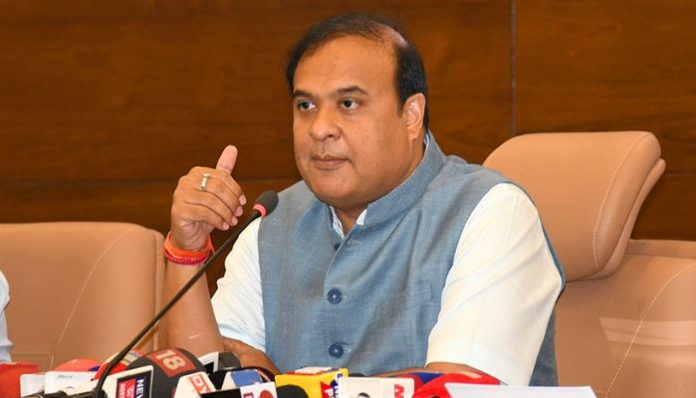
At the BJP Assam State Executive Meeting that concluded on Saturday, 27th December, Chief Minister Himanta Biswa Sarma described the upcoming Assam Assembly election as a “civilisational fight,” saying that development alone is not enough if the identity of the state is not protected.
Speaking to party workers, Sarma said the BJP’s politics is based on development, but survival and identity are equally important. He said Assam today is witnessing the presence of two different civilisations. One, he explained, is a 5,000-year-old Sanatan civilisation that accepts all forms of prayer and believes in inclusion. According to him, this civilisation has always welcomed everyone.
He claimed that because of the weakness of the Indian National Congress and its appeasement politics, another civilisation has slowly grown in the state.
Referring to census data, Sarma stated that, according to the 2011 Census, Muslims comprise approximately 34% of Assam’s population. He added that if about 3% Assamese Muslims are excluded, then Muslims of Bangladeshi origin accounted for nearly 31%.
In 2011, minorities made up 31% of Assam’s population, with many being those who came from Bangladesh.
— Himanta Biswa Sarma (@himantabiswa) December 27, 2025
By 2027, this is number expected to rise to around 40%, raising serious concerns about the changing demographic landscape of our state. pic.twitter.com/EkIvItRS13
He claimed that in every census, this number increases by around 4%, and stated that by the 2027 Census, Bangladeshi-origin Miya Muslims could comprise close to 40% of Assam’s population.
The two-day meeting was held ahead of the Assam Assembly elections, which are expected to take place in March-April next year. The meeting was attended by BJP’s new National Executive President Nitin Nabin, National Vice President Baijayant Jay Panda, National General Secretary B L Santosh, along with several senior leaders of the Assam BJP.
While laying out the party’s campaign message, Sarma also spoke about the development work done during his tenure and said that government welfare schemes have reached people across the state. Along with development, he again stressed the need to protect Assam’s cultural and social identity.
The Chief Minister also referred to the recent unrest in Bangladesh and the killing of Hindu youth Dipu Chandra Das. He said that while some people talk about co-existence, the Sanatan faith believes in accepting everyone. He added that recent incidents in Bangladesh show that the other side believes in exclusiveness.
According to him, for them, religion comes before the nation. Sarma said that seeing what happened to Dipu Das in Bangladesh makes it clear what kind of situation Assamese people might face 20 years from now.
Raising concerns over national security, Sarma spoke about the Siliguri Corridor, often called the “Chicken Neck,” which connects Assam and the Northeast to the rest of India. He said that people living on both sides of this corridor are not Hindus, but those who came from Bangladesh and settled there over time.
"People settled around 'chicken neck' won't fight for India if there is ever a war between India and Bangladesh.
— News Arena India (@NewsArenaIndia) December 27, 2025
Northeast will be taken over if Hindu population goes below 50%."
– Assam CM Himanta on infiltration pic.twitter.com/yDuw40rWB2
He questioned where their loyalty would lie if a war were to break out between India and Bangladesh, pointing out that many of their relatives still live across the border.
Towards the end of his speech, Sarma called for unity and warned against internal divisions. He indirectly referred to recent tensions in Karbi Anglong between local Karbi tribal communities and Bihari Hindus who have settled in the area. He said that as long as they are alive, every election will be a civilisational fight, fought with the resolve to protect the community and keep the “jati” alive.
