

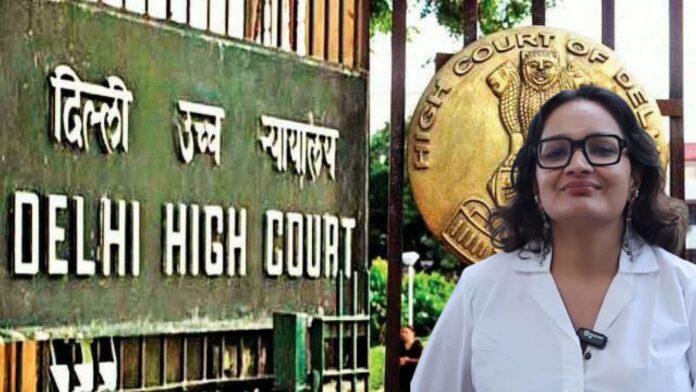
The Delhi High Court on Thursday came down sharply on the language used by Newslaundry journalist Manisha Pande in a video targeting TV Today Network, the media group that owns Aaj Tak and India Today, warning that such conduct could have serious professional consequences.
The court went on to express shock at Newslaundry for persisting with Manisha Pande, adding that she should be thrown out immediately and has no fundamentals of decency in reporting.
A Division Bench comprising Justices C. Hari Shankar and Om Prakash Shukla objected strongly to Pande’s use of the word “shit” while referring to a video related to Good News Today, a channel run by TV Today. The Bench described the expression as “gross” and plainly disparaging, signalling that the court was unwilling to treat the matter lightly.
In unusually blunt remarks from the bench, the judges cautioned that they may pass observations or orders that could severely impact Pande’s career. “Are you continuing with anchor? She should be thrown out. She has no business being a reporter. She doesn’t know the basics. She doesn’t know the fundamentals of decency in reporting,” the court said, adding that it would not hesitate to comment on her conduct in open court or even implead her personally if required. “There has to be a limit to everything… We may pass an order which will place her entire career in disarray,” the Bench warned.
The observations were made during the hearing of cross-appeals filed by Newslaundry and TV Today against a single-judge order in a long-running dispute over alleged copyright infringement, defamation and disparagement. TV Today has accused the online news platform of misusing its broadcast material and running content that damages its reputation.
Senior Advocate Rajshekhar Rao, appearing for Newslaundry, acknowledged that some of the language used in the videos could have been better chosen but argued that the case was not truly about abusive words. According to him, the lawsuit was an attempt to stifle criticism of mainstream media. “I take their clip and comment on it. Yes, I should have used better language. But somebody wants to shut me down,” Rao told the court.
TV Today’s counsel, advocate Hrishikesh Baruah, countered that the comments made by Pande and Newslaundry co-founder Abhinandan Sekhri went well beyond fair criticism. He argued that large portions of TV Today’s content were used, amounting to copyright infringement, and that the commentary crossed into disparagement of journalists and the organisation itself.
The dispute dates back to October 2021, when TV Today filed a suit alleging that Newslaundry had published videos and articles containing “false, malicious and derogatory” statements about its channels, anchors and management. Newslaundry, in turn, has maintained that its content constitutes satire and media criticism protected under free speech.
In July 2022, a single judge of the High Court declined to grant interim relief to TV Today. Both sides appealed — TV Today challenging the denial of relief, and Newslaundry objecting to the court’s observation that a prima facie case appeared to be made out against it.
While taking strong exception to Pande’s choice of words, the Division Bench also drew a clear line between disparagement and criticism. The court observed that TV Today cannot label every unfavourable video as disparaging. It held that phrases such as “method anchoring,” “thoda drama thoda gimmick,” “soap opera,” or “killing sports journalism Aaj Tak style” fall squarely within the realm of critique.
“This is commenting on what you are showing. This is criticism. How is this disparaging?” the Bench said. “Even if someone says your programme is absolute nonsense, that is not disparaging — that is a comment.”
Advocate Bani Dikshit, also representing Newslaundry, argued that expressions such as “nanga nach” must be assessed in context rather than in isolation, and stressed that Newslaundry had never claimed ownership over TV Today’s content.
In closing submissions, Senior Advocate Rao invoked Newslaundry’s founding philosophy, stating that the media has historically stood by the nation during its most difficult moments, but that something fundamental has shifted over time. “We are conscience keepers of democracy,” he said.
The Bench, however, made it clear that it would refrain from commenting on the broader state of the media. “We don’t want to express our views about what the media is doing. We are restricting ourselves,” Justice Hari Shankar said.
After hearing both sides, the court reserved its verdict in the appeals, leaving open critical questions on the boundaries between criticism, decency, and legal accountability in media commentary.
