

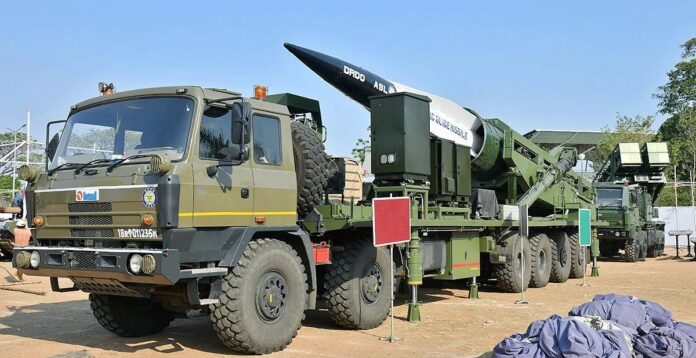
India marked a signsignificantestone in its strategic and technological capability as the Defence Research and Development Organisation (DRDO) unveiled the country’s first hypersonic missile during the 77th Republic Day Parade at Kartavya Path. The debut of the Long-Range Anti-Ship Hypersonic Glide Missile (LRAShM) underscored India’s growing prowess in advanced weapons development and its push for self-reliance in defence manufacturing.
The parade was witnessed by around 10,000 special guests, including innovators, researchers, start-up founders, and top performers under various government initiatives. Adding to the diplomatic significance of the occasion, President of the European Council, Antonio Costa, and President of the European Commission, Ursula von der Leyen, attended the celebrations as Chief Guests, marking a first for the European Union’s top leadership at India’s Republic Day.
India Unveils its First Hypersonic Missile – the Long Range Anti Ship Missile (LRAShM)
— Sanbeer Singh Ranhotra (@SSanbeer) January 26, 2026
With a reported range exceeding 1,500 kilometres and a speed of Mach 10, this bad boy will be the killer of Aircraft Carriers in the Indian Ocean.
Kudos to @DRDO_India! This was easily the… pic.twitter.com/Rar83lEWe0
All about the LRAShM
Developed entirely by DRDO, the LRAShM is a long-range, sea-denial weapon designed to meet the operational requirements of the Indian Navy. The missile has an estimated range of around 1,500 kilometres and can strike designated targets in roughly 15 minutes, owing to its hypersonic speed, well beyond Mach 5.
Its advanced design and high aerodynamic efficiency make it extremely difficult for adversary radars and ship-based air defence systems to detect, track, or intercept. Capable of carrying multiple types of payloads, the LRAShM is designed to destroy all classes of enemy warships deployed in the ocean domain, significantly enhancing India’s maritime strike capability.
“This will increase India’s capability in the ocean waters. DRDO is working on hypersonic glide missile technology and hypersonic cruise missile technology,” Project Director A. Prasad Goud told news agency ANI. He added that the missile’s hypersonic nature gives it a decisive edge, as enemy radars are unlikely to detect it in time to mount an effective defence.
According to DRDO officials, the LRAShM forms part of a broader, ongoing programme focused on hypersonic glide and hypersonic cruise missile technologies. Future variants of the missile are expected to extend the range to as much as 3,500 kilometres, further strengthening India’s long-range precision strike capabilities.
Showcase of ndigenous military systems
The hypersonic missile was among several indigenously developed defence platforms featured at the Republic Day Parade. Other systems on display included the Dhanush Gun System, Akash (L) Launcher, Suryastra Universal Rocket Launcher System, and Akash surface-to-air missiles, highlighting the depth and diversity of India’s domestic defence ecosystem.
Republic Day celebrations
As part of the Republic Day programme, special guests also paid tribute at the National War Memorial and visited the Prime Ministers’ Museum and Library (PM Sangrahalay), where they interacted with Union ministers and senior officials.
The unveiling of the LRAShM, in the presence of prominent international leaders such as Ursula von der Leyen, sent a clear signal of India’s technological ambitions and its intent to emerge as a major player in cutting-edge defence technologies, particularly in the strategically vital Indo-Pacific maritime domain.
