

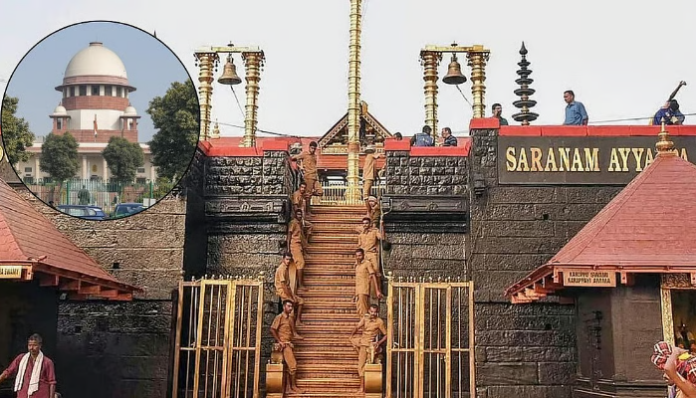
On 16th February (Monday), the Supreme Court decided a hearing date to consider multiple review and writ petitions about the September 2018 ruling that permitted women of menstrual age to access the Lord Ayyappa temple, also known as Sabarimala Sree Dharma Sastha temple in Kerala. The matter to be heard on 7th April is listed before a nine-judge Constitution Bench. On 22nd April, the hearing will come to an end.
Chief Justice of India Surya Kant, Justices Joymalya Bagchi and Vipul M Pancholi issued instructions for the reference to be listed before the proposed panel. Kant will separately issue an administrative order to announce the structure of the bench. The arguments endorsing the judgment review will take place from 7th to 9th April. The dates for the contentions by the opposing parties are from 14th to 16th April. The rejoinder submissions are scheduled for 21st April.
“The nine-judge bench will begin hearing the Sabarimala review case on April 7, 2026 at 10:30 am. The review petitioners or the party supporting them shall be heard from April 7 to April 9. The ones opposing the review shall be heard on April 14 to April 16. The rejoinder submissions if any will be heard on April 21 followed by the final and concluding submissions by the learned amicus which is expected to be over by April 22. The parties shall adhere to the above time schedule. The nodal counsels in consultation with arguing counsel of the parties shall prepare the internal arrangement so that oral submissions from both sides can be heard within the stipulated timeline,” the court stated.
The court stated that a previous nine-judge bench, created in 2019 by then Chief Justice of India Sharad A. Bobde, had already determined whether the review petitions were maintainable. The eruption of the COVID outbreak forced an early end to the bench sessions.
The Sabarimala temple admission dispute will be resolved after the panel considers seven significant legal issues regarding religious freedom and liberties. “We may advert to the order dated Feb 10, 2020, framing the seven questions to be determined by the nine-judge bench. With a view to answering the questions that remained pending, we direct parties to file their written submissions on or before March 14, 2026,” the Court said in its order today,” the court added.
Speaking on behalf of the Modi government, Solicitor General Tushar Mehta said he agreed to requests for a review of the Sabarimala judgement. Krishna Kumar Singh, a lawyer nominated by the bench, was designated as the nodal counsel for the parties in favour of the Sabarimala verdict’s review. Shashwati Pari was appointed as the nodal attorney for those against the review.
The court further mentioned, “We also deem it appropriate that Senior Advocate K Parameshwar, with Shivam Singh, are appointed as amicus. Singh shall submit the stand taken by all parties before this court.”
Background of the matter
The Supreme Court ruled in November 2018 that “devotion cannot be subjected to gender discrimination,” allowing women of all ages to enter the Sabarimala temple by a 4:1 majority. Then, Justice Indu Malhotra, the only female judge on the bench, dissented from the majority, which was made up of CJI Dipak Misra, Justices RF Nariman, AM Khanwilkar and DY Chandrachud.
According to the CJI’s ruling, followers of Lord Ayyappa will not form a distinct religious sect. Additionally, Rule 3(b) of the Kerala Hindu Places of Public Worship (Authorisation of Entry) Rules 1965 which forbade women from entering Sabarimala was removed as illegal.
A five-judge Constitution Bench, presided over by then Chief Justice of India Ranjan Gogoi, issued a majority ruling in November 2019 referring the Sabarimala review and writ petitions to a seven-judge bench. The 2018 Sabarimala ruling was contested in more than 60 review and writ petitions.
The petitions addressed to the traditions of excommunication and female genital mutilation among the Dawoodi Bohra community, the admittance of Muslim women into mosques and dargahs along with the entry of Parsi women into fire temples if they had married a non-Parsi, were listed along with the aforementioned pleas.
The 2019 ruling had raised legal issues, such as whether important religious practices should be protected by the constitution and how much the court may intervene in a fundamental religious rite.
The court made the decision to postpone the review petitions in the Sabarimala case till a larger bench makes decisions on matters related to fundamental religious rituals. It was stated that a larger bench was needed to consider the issue of whether the court could meddle in basic religious practices.
The 2019 nine-judge bench was formed because it was required to examine a 1954 decision by a seven-judge bench in the Shirur Mutt case. The latter examined what constituted “essential religious practices” for the first time and pronounced that “what constitutes the essential part of a religion is primarily to be ascertained with reference to the doctrines of that religion itself.” It lapsed due to the retirement of eight of its members.
