

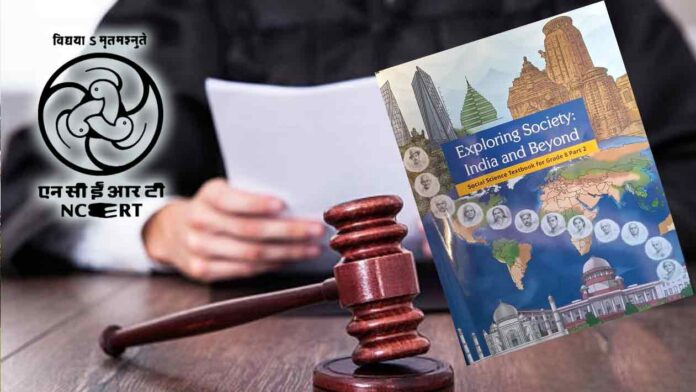
The National Council of Educational Research and Training (NCERT) has included a section on “corruption in the judiciary” in its new Social Science textbook for Class 8 for the first time. It is a part of a chapter on “The role of the judiciary in our society,” and represented an important modification from previous books that mostly concentrated on the structure, along with the function of courts. The fresh edition of “Exploring Society: India and Beyond” was released on 23rd February (Monday).
The updated chapter discusses issues confronting the judiciary, such as corruption and backlogs of cases, in addition to outlining its hierarchy and access to justice. According to the chapter, there are currently over 81,000 cases outstanding in the Supreme Court, 62,40,000 in the High Court and 4,70,00,000 in the district and subordinate courts.
“Corruption at various levels of the judiciary” and “massive backlog on account of multiple reasons, such as a lack of an adequate number of judges, complicated legal procedures, and poor infrastructure” are listed as two of the “challenges” faced by the judicial system, in addition to multiple others.
Corruption was not in the previous textbook, and it simply covered the responsibilities of the judiciary, the meaning of an independent judiciary, the structure of the courts and how they can be approached. However, it contained a statement noting that the period it takes for courts to hear a matter is a factor that impacts the average person’s access to justice. It also pointed out that the adage “justice delayed is justice denied” is frequently employed to describe the span of time that courts require.
According to the book’s section on “corruption in the judiciary,” judges are subject to a code of conduct that establishes guidelines for both their actions in and out of court. It alludes to the internal accountability-maintenance process of the judiciary and specifies an “established procedure for receiving complaints through the Centralised Public Grievance Redress and Monitoring System (CPGRAMS).” It informs that between 2017 and 2021, more than 1,600 of these complaints were received.
The chapter reads, “In cases where the allegations are serious, the Parliament can take action and remove a judge by passing a motion of impeachment. Such a motion is considered only after a proper inquiry, during which the judge is given a fair opportunity to present their side of the case.”
“Nevertheless, people do experience corruption at various levels of the judiciary. For the poor and the disadvantaged, this can worsen the issue of access to justice. Hence, efforts are constantly being made at the State and Union levels to build faith and increase transparency in the judicial system, including through the use of technology, and to take swift and decisive action against instances of corruption wherever they may arise,” it further conveys.
“Sadly, there have been instances of corruption and misconduct that have surfaced even within the judiciary. Such occurrences inevitably have a negative impact on public confidence, potentially eroding faith in the integrity of the system as a whole. However, the path to rebuilding this trust lies in the swift, decisive and transparent action taken to address and resolve these issues. Any erosion of this confidence risks weakening the judiciary’s constitutional role as the ultimate arbiter of rights. Transparency and accountability are democratic virtues,” the chapter cites former Chief Justice of India B R Gavai, who remarked in July of last year.
The book asks students to weigh in on two instances, the Information Technology Act and electoral bonds, after a section on “Why is an independent judiciary needed for justice?” According to it, the government launched electoral bonds in 2018 to help political parties gather money by enabling private donations from people and businesses.
The book highlights, “Issued by banks, they could be redeemed only by registered political parties that met certain criteria. However, the Supreme Court struck this provision down as being unconstitutional, stating that voters have a right to know who is funding political parties.”
The book stated that a few years after the “Information Technology Act, 2009” went into effect, the government inserted a provision that allowed imprisonment for social media posts. A law student contested this provision in court in 2015, countering that it infringed upon the right to free speech.
The Supreme Court agreed and termed it unconstitutional, after which the government was told to strike it from the act. Students are asked about what the court did in each of these cases and the reasons behind these decisions.
New textbooks for every class have been created by the NCERT in accordance with the National Curriculum Framework (NCF) for School Education and the National Education Policy, 2020. New books for Classes 1 through 8 have been published thus far. The first section of the Class 8 Social Science textbook came out in July 2025. After the Covid epidemic, the content load of the old textbooks, which were based on the NCF of 2005, was decreased, and they were rationalised.
