

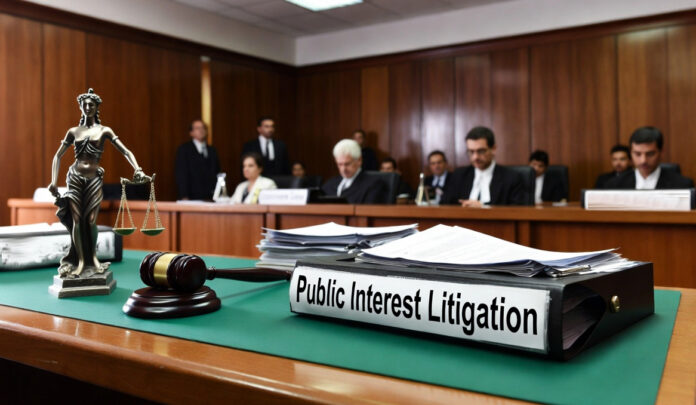
In the written submissions filed before the 9-judge Constitution Bench of the Supreme Court hearing the Sabarimala reference, the Centre put forward 10 major arguments urging the top court to lay down a lasting judicial framework to guide the constitutional courts in dealing with religious disputes, handle Public Interest Litigations (PILs), and interpret the freedom of religion.
One of the arguments made by the centre before the Apex Court sought the removal of Public Interest Litigation (PIL) as a jurisdictional exception and the restoration of the general principles of locus standi. The centre highlighted how the PIL mechanism is being increasingly misused to challenge religious customs by those who do not even personally practice the customs concerned. One of the key questions being examined by the top court is whether a person not belonging to a religious denomination or a religious group can challenge a practice of that religious denomination or religious group by filing a PIL.
Appearing for the Centre, Solicitor General Tushar Mehta said that relaxation of the principle of locus standi in relation to the PIL was originally meant to ensure access to justice to the poor and the marginalised sections of society. But the PIL mechanism has come to be abused by activists and vested interests for interfering with and challenging the religious traditions of a religious denomination before courts.
The ASG said that the current position of the PIL in India, which allows any member of the public to challenge any law without proving any personal injury, and in the name of ‘public interest’, has emerged as a “global constitutional anomaly”, which is not found in any other major democracy.
The centre called for the removal of the PIL jurisdiction and a return to strict principles of locus standi, saying that the Sabarimala case was a prime example of “a PIL filed by persons with no personal stake, representing no identifiable class of inaccessible victims, against a practice they did not follow, in respect of a deity they did not worship”.
The centre further argued that the jurisdictional exception granted to the PIL has “swallowed the rule”, and instead of benefitting the disadvantaged sections of society, it is now being used as an “open-standing rule” by urban professionals, NGOs, and activists.
The centre also argued that the reason for establishing the PIL system has almost disappeared. PILs were allowed and strengthened to allow anyone to file petitions on behalf of people who can’t access the judiciary. The centre noted that with the development of a robust statutory legal-aid framework under the National Legal Service Authority (NALSA), the development of e-court, and widespread availability of internet, physical barriers for the poor to approach the courts no longer exist. As a result, the PIL doctrine had “outlived the factual conditions” of its birth, the govt said.
The 9-judge Bench of the Supreme Court is hearing the petitions challenging the 2018 verdict of the Supreme Court in the Sabarimala case delivered by a Constitution Bench. The verdict, which allowed the entry of women of menstruating age into the Ayyappa temple in contravention of the religious customs, was widely opposed by Ayyappa devotees, including women.
The core argument is one of locus standi – if a person does not belong to the denomination and does not worship the deity, they do not have the legal standing to challenge its internal traditions. The Sabarimala petition was filed by activist lawyers, not devotees.
