

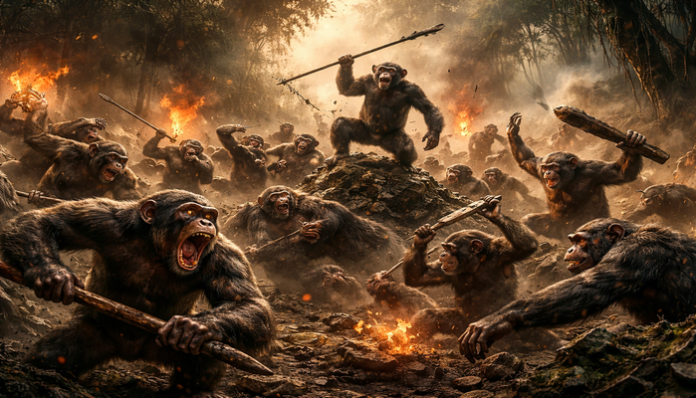
While the human world is currently witnessing a war in West Asia involving multiple nations, recent research has revealed that war and destruction are not exclusive to the human species. Research conducted on the Kibale National Park in Uganda, under the Kibale Chimpanzee Project, uncovered a deadly civil war that has been going on among the chimpanzee community of Uganda.
According to the findings of the research, the world’s largest chimpanzee community residing in the depths of the national park has split into two factions, which have been engaging in brutal warfare for about a decade. The Ngogo chimpanzee community has been living in the forest for around two decades. The members of the community have developed strong relationships and social cooperation among themselves. However, things took a downward turn between 2015 and 2018, leading to the erosion of social harmony and the breakout of a civil war.
A study titled ‘Lethal conflict after group fission in wild chimpanzees’ was done by the Department of Anthropology, University of Texas, drawing on 30 years of demographic data, a decade of GPS tracking, and 24 years of detailed field observations to explain civil war in the chimpanzee community, which became visible in 2018. Ever since, around 28 chimpanzees, including babies, have been killed, and several have gone missing.
What caused the Civil War
According to the study, a contributive factor to the civil war was the death of influential males of the community who kept the community bound together. Their passing changed power dynamics within the community and weakened the relationships and the coordination. Five elderly males and one adult female died of possible respiratory illness in 2014. According to researchers, their death corroded the bonds among the group members, as they gradually stopped meeting one another and started drifting. Over time, the drift widened and hostility increased.
Researchers believe that one incident that happened in 2019 marked a turning point for the internal harmony of the chimpanzee community. In that year, a chimpanzee named Basie, who was in his 36th year in the forest, was killed by other chimpanzees. Basie was having a usual day until 13 adult chimpanzees from a rival faction suddenly attacked him. The chimpanzees surrounded him, dragged him to the ground, and launched a coordinated attack, incessantly hitting and biting him, causing his death.
The killing of Basie was the second such incident in the community, but the brutality of the act created an everlasting atmosphere of hostility in the chimpanzee community. The behaviour observed in the chimpanzee community after the incident was not just brutal, but demonstrated well-organised, planned violence. Hostile groups formed within the community, which carried out targeted attacks, mostly on lone individuals. The violence and the brutality of their attacks resembled human warfare. Territorial incursions, coalitions, and even infanticide were witnessed.
“What’s especially striking is that the chimpanzees are killing former group members,” said Aaron Sandel, associate professor of anthropology at UT Austin and the study’s lead author. According to the researchers, the war was similar to the Gombe Chimpanzee War, which was witnessed by Jane Goodall in the 1970s between two chimp factions in Tanzania’s Gombe Stream National Park.
On the basis of the study, the researchers rejected the idea that inherent violence is limited to humans. The civil war in the chimpanzee community was not a result of external factors but was caused by internal stress factors within the community, such as conflicts, hierarchies, competition, and resource scarcity. “This study encourages a reevaluation of current models of human collective violence. If chimpanzee groups can polarise, split, and engage in lethal aggression without human-type cultural markers, then relational dynamics may play a larger causal role in human conflict than often assumed,” the study stated.
Apart from the chimpanzees, ants have also been observed to have demonstrated patterns of survival, conflict and even colonisation similar to humans. Research has revealed that some unicolonial ant species are very brutal when it comes to their survival as well as expansion. These ant species are natural invaders who conquer the territories of other species and establish their colonies there.
