

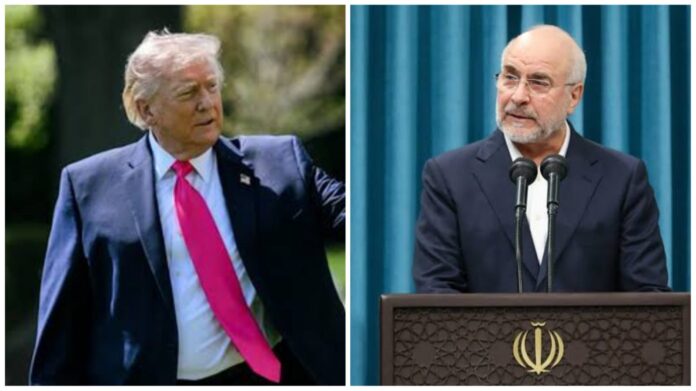
Iran’s Parliament Speaker Mohammed Bagher Ghalibaf has outright rubbished Donald Trump’s claims, accusing the US President of peddling “falsehoods” and insisting that Washington’s narrative will neither win wars nor negotiations.
In a sharp escalation, Ghalibaf warned that the Strait of Hormuz, one of the world’s most critical oil corridors, will not remain open if the United States continues its naval blockade of Iranian ports. He made it clear that any movement through the strait would now depend strictly on Iranian authorisation and designated routes, signalling Tehran’s readiness to tighten control if pressure persists.
۱- رئیس جمهور آمریکا در یک ساعت هفت ادعا مطرح کرد که هر هفت ادعا کذب است.
— محمدباقر قالیباف | MB Ghalibaf (@mb_ghalibaf) April 17, 2026
۲- با این دروغگوییها در جنگ پیروز نشدند و حتما در مذاکره هم راه به جایی نخواهند برد.
۳- با ادامهٔ محاصره، تنگهٔ هرمز باز نخواهد ماند.
The warning comes amid conflicting signals from Tehran itself. Just hours before Ghalibaf’s remarks, Iran had declared the Strait “completely open” for commercial shipping during the ongoing ceasefire window. Foreign Minister Abbas Araghchi attempted to calm global markets, stating that vessels could pass safely along pre-approved routes under Iranian coordination.
Washington, however, is holding its ground. Trump has said the naval blockade will continue in “full force” until a broader deal with Iran is finalised, despite simultaneously claiming that negotiations are close to completion. He has also warned of renewed military action, saying the US could “start dropping bombs again” if talks collapse.
Tehran has categorically rejected several of Trump’s assertions. Notably, his claim that Iran agreed to transfer its enriched uranium stockpile to the US has been dismissed as baseless, with Iranian officials insisting no such proposal has ever been part of negotiations.
At the centre of this standoff lies the Strait of Hormuz, a narrow but vital passage that carries roughly 20% of global oil supply. Even though Iran has announced its reopening, uncertainty persists. Shipping activity remains hesitant, with vessels seeking clearer security guarantees before resuming normal transit.
Strategically, analysts now view Hormuz as more than just a trade route; it has effectively become a pressure lever, almost akin to a “deterrent,” allowing Iran to impose immediate global economic consequences without direct military escalation.
What emerges is a deeply fragile situation: a ceasefire on paper, negotiations in motion, but ground realities shaped by mutual distrust, military pressure, and sharply conflicting narratives.
