

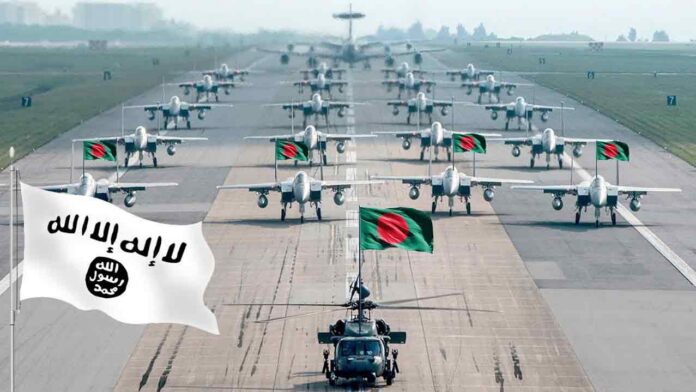
Bangladesh’s Air Force is on high alert following a series of intelligence-led raids across multiple bases that uncovered an alleged network of officers and airmen with ties to the banned Pakistani militant group Tehrik-e-Taliban Pakistan (TTP). The operation, which began in the early hours of 20 April, has led to the arrest of at least two squadron leaders, nearly ten junior commissioned officers (JCOs) and airmen, and the detention of around a dozen others for questioning. Several more personnel are reported to have fled the country.
The story was first broken by Indian journalist Chandan Nandy in Northeast News on 23 April 2026, with follow-up reports on 24 and 25 April detailing the extent of the alleged infiltration. Bangladeshi media outlets have largely avoided direct coverage of the sensitive military matter, though some portals have since reported on the developments, citing the NE News articles and noting a subsequent spike in police alertness in and around the base.
As per the report, BAF’s intelligence wing raided several servicemen on at least two air force installations in Dhaka in the early hours of April 20, based on surveillance inputs generated over a considerable period of time. During these raids, 2 officers were arrested, and 10 more were detained for questioning.
According to the reports, the investigation was triggered when a Bangladesh Air Force Warrant Officer posted at Zahurul Haque Air Base in Chittagong went absent without leave (AWOL) two months ago. Pakistani authorities traced him to a TTP hideout in the Khyber Pakhtunkhwa province (formerly Northwest Frontier Province), where he was arrested in collaboration with Pakistani authorities. Under interrogation by Pakistani army, intelligence, and police officers, the officer reportedly confessed that TTP was in contact with other BAF personnel and revealed details of a months-long TTP recruitment drive within the Bangladesh Air Force. Pakistani officials subsequently shared the information with their Bangladeshi counterparts.
The disclosures prompted immediate action by the BAF’s own intelligence wing. Raids were conducted over eight to nine days at three key installations: Zahurul Haque Air Base in Chittagong, A K Khandakar Base at Kurmitola in Dhaka, and Matiur Rahman Base in Jessore. Several personnel were apprehended during these raids. Among those detained were four to five airmen from the Cox’s Bazar unit, while the others were detained from the 25th Squadron in Chittagong and the 18th Squadron in Jessore, which is involved in radar operations. Two absconding airmen had been stationed at the Dhaka base and one at the Airmen Training Institute attached to Zahurul Haque.
Investigators have identified Abdus Shukur, imam of the main mosque at Zahurul Haque Air Base, as the suspected principal TTP recruiter. He is believed to have been approached by the group’s “talent spotters” at least six months ago and was arrested during the raids. At least 10-12 other Air Force personnel, including Warrant Officers, already recruited by TTP, are said to have fled to Turkey, Pakistan, New Zealand, and Portugal after news of the network spread.
The North East News revealed that Bangladeshi authorities identified a person named Istiyak Ahmed, alias Sami, alias Abu Bakkar, alias Abu Mohammad, who maintained “regular communication with two dismissed members of the armed forces.” Istiyak Ahmed was arrested and arrested and interrogated, and he named others involved in the network.
Bangladeshi media house The Sun 24 reported that the raids appear to stem from intelligence indicating an attempt to establish a TTP training facility at Ukhia in Cox’s Bazar district. The portal noted that Bangladeshi police have since issued urgent alerts to senior officers, including Range DIGs, Metropolitan Police Commissioners, and Superintendents of Police, warning of possible attacks by supporters of a banned extremist group on sensitive sites such as Parliament, law-enforcement buildings, religious centres, entertainment venues, Shahbagh, and armouries. These advisories follow the discovery of links between the banned organisation and both serving and recently dismissed military personnel.
Follow-up reporting by Northeast News indicated that Bangladesh police have now begun probing connections between the TTP and at least two former army soldiers, expanding the scope of the investigation beyond the Air Force. Security sources told the outlet that prior BAF advisories had already flagged potential links with the TTP.
Bangladeshi authorities have not publicly confirmed the details of the arrests or the scale of the operation. The TTP, which is banned in Pakistan and maintains ties to the Afghan Taliban, has also not issued any comment on the allegations.
