

India and New Zealand are set to formalise a historic Free Trade Agreement (FTA) tomorrow, April 27, 2026, in New Delhi, marking a major milestone in bilateral economic relations after negotiations that were concluded in record time.
The pact, finalised in December 2025 following the launch of talks in March 2025, is one of India’s fastest-negotiated trade deals. It will grant 100% duty-free access to all Indian exports entering New Zealand while providing New Zealand exporters with tariff elimination or sharp reductions on 95% of its current exports to India. More than half of New Zealand’s exports, including lamb, wool, forestry products, kiwifruit, apples, and mānuka honey, will enjoy duty-free entry from day one.
Commerce Minister Piyush Goyal welcomed New Zealand’s Trade and Investment Minister Todd McClay to the capital on Friday, hailing the agreement as a boost for Indian exporters, particularly in labour-intensive sectors such as textiles, leather, footwear, engineering goods, pharmaceuticals, and select agricultural products. MSMEs are expected to be among the biggest beneficiaries.
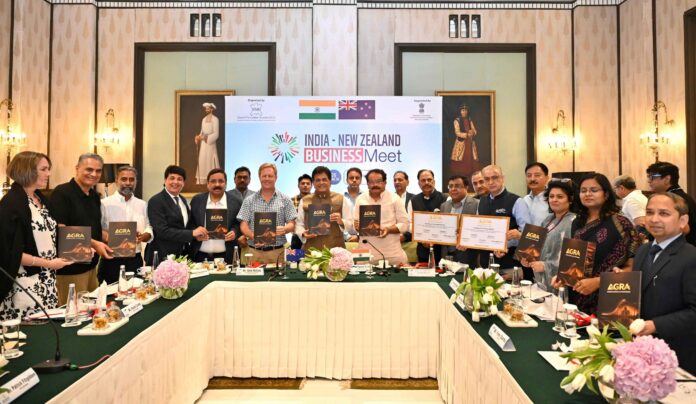
Ahead of the signing of the agreement tomorrow, Union Commerce and Industry Minister Piyush Goyal and New Zealand’s Trade and Investment Minister Todd McClay met industry leaders at an event in Agra today. Leaders from the leather & footwear, AYUSH, pharma, medical devices, light engineering & sports goods sectors joined the event.
Had an enriching industry engagement in Agra with leaders from the leather & footwear, AYUSH, pharma, medical devices, light engineering & sports goods sectors, joined by my friend Mr. @ToddMcClayMP, Minister for Trade & Investment, New Zealand.
— Piyush Goyal (@PiyushGoyal) April 26, 2026
Also, launched the 'Agra: World… pic.twitter.com/bV1TqAWYST
Minister Goyal said that the FTA marks a defining milestone, unlocking new opportunities for our farmers, women, artisans, MSMEs, businesses & skilled professionals. Todd McClay said that India is a strategic priority for New Zealand and urged businesses to actively pursue joint ventures & investment in India.
For New Zealand, the deal opens access to India’s 1.4-billion consumer market. Prime Minister Christopher Luxon described it as a “once-in-a-generation” opportunity that will help Kiwi businesses “compete on equal footing in one of the world’s fastest-growing economies.” The government projects additional exports worth tens of millions of dollars annually, with further gains in wine and services.
Sensitive sectors in India have been carefully protected in the deal. India has kept its core dairy industry largely out of the concessions to safeguard domestic producers, though limited phased access has been provided for certain dairy-based preparations such as infant formula and a small quota for albumins. A fast-track mechanism will also facilitate duty-free supply of some New Zealand dairy products for further manufacturing and re-export.
Beyond goods trade, the FTA includes forward-looking provisions. New Zealand has committed to facilitating US$20 billion in long-term investments into India over the next 15 years. In mobility, a new Temporary Employment Entry (TEE) visa program will allow up to 5,000 skilled Indian professionals (capped at 1,667 per year) to work in New Zealand for up to three years in sectors such as IT, healthcare, engineering, education, and construction. Additional student mobility and post-study work visa arrangements are also part of the deal.
The two countries currently have modest bilateral trade, and the agreement aims to more than double flows to reach $5 billion within five years.
Tomorrow’s signing ceremony at Bharat Mandapam in New Delhi is expected to be attended by a large delegation of business leaders from both nations. The event will be followed by the release of the full text of the agreement.
In New Zealand, the pact will then enter a standard parliamentary scrutiny process, including review by a select committee and public submissions, before enabling legislation is passed.
Trade and Investment Minister Todd McClay said the deal levels the playing field for New Zealand exporters who have long faced higher tariffs compared to competitors from other countries with FTAs with India.
The India-New Zealand FTA comes at a time of deepening strategic partnership between the two democracies and is being viewed as a significant step in strengthening economic ties in the Indo-Pacific region.
