

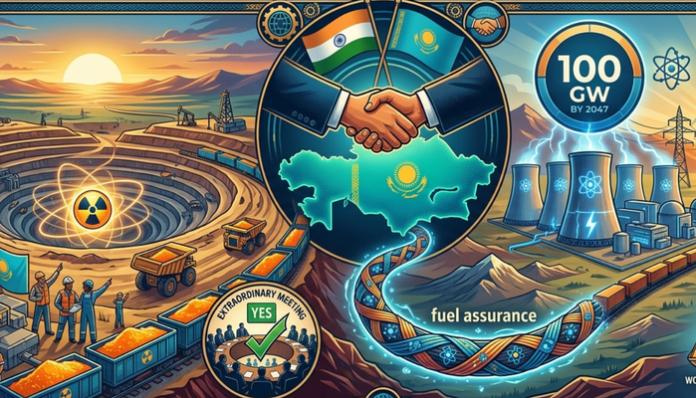
In a step towards diversifying the country’s energy sources, India signed a major Uranium procurement deal with Kazakhstan’s uranium giant Kazatomprom. The deal, worth over US$4 billion (roughly ₹35,000 crore), is one of Asia’s largest uranium supply arrangements. It is being hailed as one of the most consequential nuclear fuel partnerships of the decade.
The impact of the deal is expected to extend beyond civilian power generation and influence the global nuclear energy balance, as well as the landscape of strategic energy security. The scale of the deal can be inferred from the fact that Kazatomprom had to convene an ‘Extraordinary General Meeting’ to obtain approval for it. The deal was sealed after 92.9% of Kazatomprom’s shareholders voted in its favour, as reported by Defence Security Asia.
The agreement covers the long-term scale and physical supply of natural uranium concentrate (U₃O₈) to India’s Directorate of Purchase and Stores, operating under the Department of Atomic Energy. The arrangement will create a multi-layer fuel assurance mechanism ensuring an uninterrupted supply to India’s expanding reactor fleet for years to come.
Both India and Kazakhstan are set to benefit from the deal in the long run. For India, a consistent and uninterrupted supply of uranium secured by the deal will contribute to achieving its ambition of reaching 100 GW of nuclear generation capacity by 2047 amid rising electricity demand and volatile fossil fuel geopolitics.
Similarly, through the deal, Kazakhstan has secured one of the world’s fastest-growing economies as a sovereign nuclear customer. Besides, the deal reinforces Kazakhstan’s position as the dominant global uranium supplier responsible for roughly 40 to 43 per cent of total world mine production.
Additionally, given the scale of the deal, it removes a huge volume of uranium from the open market, which is likely to impact the global supply conditions. The deal also inspires long-term bilateral contracts that are rapidly replacing spot-market dependence.
It is estimated that the agreement secures a significant portion of Kazatomprom’s production pipeline for India. This translates into preferential access for India even during times of increasing scarcity within the global uranium cycle. It gives India a significant advantage amid growing global competition for energy supplies.
Kazatomprom produced 25,839 tons of uranium in 2025 and has projected a production volume of 27,500 to 29,000 tons for 2026. India currently has 24 operational nuclear reactors, having an estimated installed capacity ranging between 8 and 10 GW. India aims to achieve a massive expansion, reaching a capacity of 100 GW by the year 2047. An additional 22.5 GW of capacity is projected to be added between 2031 and 2035.
