

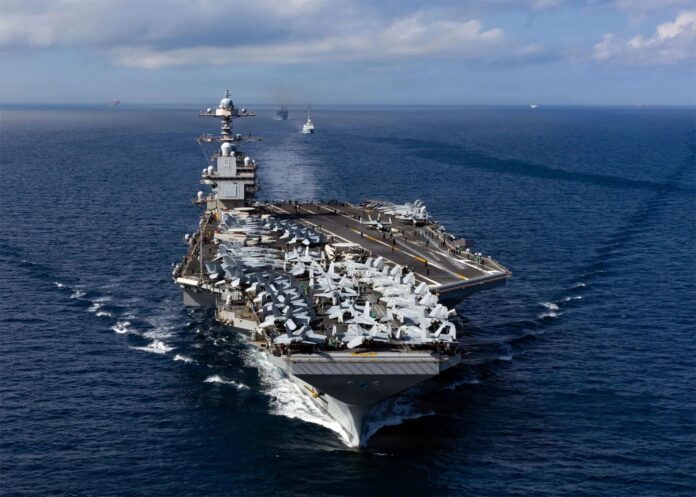
The world’s most powerful aircraft carrier, the USS Gerald R. Ford, has quietly exited the Middle East after months of high-intensity operations against Iran, marking a subtle but significant shift in America’s military posture in the region.
Its departure leaves behind two other US supercarriers, the USS Abraham Lincoln and the USS George H.W. Bush, along with roughly 20 naval vessels still deployed in the volatile theatre.
But the Ford’s exit is far from routine. The nuclear-powered giant has just wrapped up a gruelling deployment of over 10 months, one of the longest in recent history, stretching from the Caribbean to the Middle East. During this period, it was involved in a wide spectrum of missions: from intercepting drug-smuggling operations and enforcing sanctions at sea to participating in direct pressure operations against Iran.
Behind the scenes, however, the deployment exposed cracks beneath the surface of American naval dominance. In March, a fire broke out onboard, injuring sailors and damaging living quarters, forcing emergency responses mid-mission. At the same time, reports of persistent technical issues, including malfunctioning onboard sanitation systems, painted a less glamorous picture of life aboard the $13 billion warship.
Strategically, the timing of the Ford’s withdrawal is critical. The United States and Iran remain locked in an uneasy, open-ended ceasefire, one that has paused outright hostilities but resolved little. Tehran continues to choke the vital Strait of Hormuz, a global artery, while US forces maintain a blockade targeting Iranian ports.
In effect, while one of America’s most formidable symbols of power sails away, the conflict it helped shape is far from over. The hardware may be rotating but the standoff remains very much alive.
