

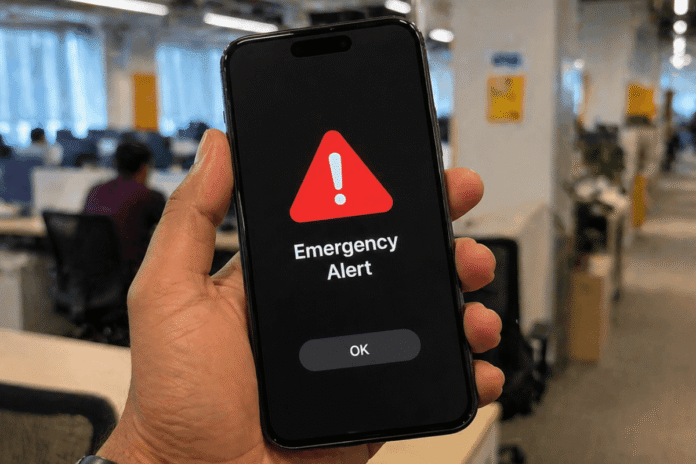
On Saturday morning, May 2, 2026, lakhs of residents across the country were caught off guard as their mobile phones began vibrating loudly and simultaneously.
The unfamiliar alert tone, distinct from routine notifications, triggered confusion, and in many cases, outright panic. Within minutes, social media platforms were flooded with posts from users asking the same question: “What just happened?”
What many initially perceived as a security scare or cyber anomaly was, in fact, a planned test of India’s next-generation emergency warning infrastructure.
What triggered the Nationwide Buzz?
They were part of a pilot rollout of a Cell Broadcast Alert System, spearheaded by the National Disaster Management Authority (NDMA). Around 11:45 AM, test messages were transmitted to mobile devices across NCR to evaluate the system’s real-time reach and reliability.
Unlike traditional SMS alerts, which are sent individually and can be delayed during network congestion, this system uses cell broadcast technology to deliver messages instantly to all devices connected to specific mobile towers. The result: millions of phones buzzing at once, efficient in design, but startling in execution.
A step forward in strengthening how we communicate during critical situations.
— DoT India (@DoT_India) May 2, 2026
The Department of Telecommunications, in coordination with key national agencies, is set to launch an advanced public alerting framework aimed at enabling timely communication during critical… pic.twitter.com/0uUu5AQ7hs
Why this system matters
The new alert mechanism has been developed to address a critical vulnerability, communication breakdown during emergencies. In crisis situations like earthquakes, tsunamis, lightning strikes, or industrial disasters, conventional telecom networks often become overloaded, delaying crucial information.
By contrast, cell broadcast messages are:
- Simultaneous: Delivered to all users in a defined geographic zone
- Network-independent: Do not rely on standard SMS traffic
- Geo-targeted: Can alert only affected areas
- Multilingual: Designed to reach diverse populations
According to Union Minister Jyotiraditya Scindia, the system represents a major leap toward “near real-time, geo-targeted alerts” aimed at strengthening disaster response and prioritizing citizen safety.
यदि आपके मोबाइल पर इस प्रकार का संदेश प्राप्त हुआ है, तो घबराने की आवश्यकता नहीं है। यह भारत की नई मोबाइल आधारित आपदा संचार प्रणाली का एक परीक्षण संदेश है, जिसे @DoT_India की C-DOT टीम ने @ndmaindia के सहयोग से सेल ब्रॉडकास्ट तकनीक के माध्यम से विकसित किया है।
— Jyotiraditya M. Scindia (@JM_Scindia) May 2, 2026
अब भविष्य में इसी… pic.twitter.com/xDxKYMnDul
Built for scale, designed for crisis
The technology has been developed by the Department of Telecommunications (DoT) in collaboration with the NDMA and technical teams at C-DOT. It is being integrated with India’s existing SMS-based alert systems to create a layered communication network capable of functioning even under stress.
Officials clarified that receiving multiple alerts is expected during testing phases, as different cell towers are activated sequentially. There is no action required from users upon receiving such test messages.
Not everywhere, not everyone
Authorities confirmed that the test was limited in scope. Regions near international borders and states undergoing elections were excluded to avoid any unintended complications. For instance, parts of West Bengal, particularly South 24 Parganas, where repolling is underway, were not included following directives from the Election Commission of India.
The road ahead
India’s move toward a robust, technology-driven disaster communication system aligns with global best practices. Countries like Japan and the United States have long relied on similar cell broadcast mechanisms for public safety alerts.
