

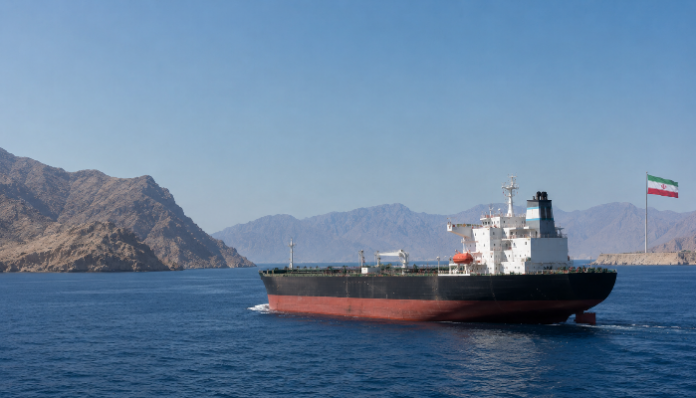
A new government agency set up by the Islamic Republic of Iran, has been tasked with controlling ship traffic through the Strait of Hormuz, reported CNN and Lloyds List. The Persian Gulf Strait Authority (PGSA) is going to collect tolls from ships that use the vital waterway which accounts for around 20% of all international oil trade.
It has been portrayed by Tehran as a regulatory body in charge of managing maritime passage through the area. The vessels will be granted permission to sail via the corridor after they submit details, including ownership documents, insurance details, crew manifests and planned transit routes using email. They must fill out the “Vessel Information Declaration,” the application form provided by PGSA, to guarantee safe crossing.
More than 40 questions are included on the form, including information about the ship’s name, identification number, past names, place of origin and destination, nationalities of registered owners, operators and crew along with cargo details. Press TV, an English-speaking Iranian station, also revealed that Tehran had established a “system to exercise sovereignty over the Strait of Hormuz” and that ships travelling through the strait received “regulations” from the email [email protected].
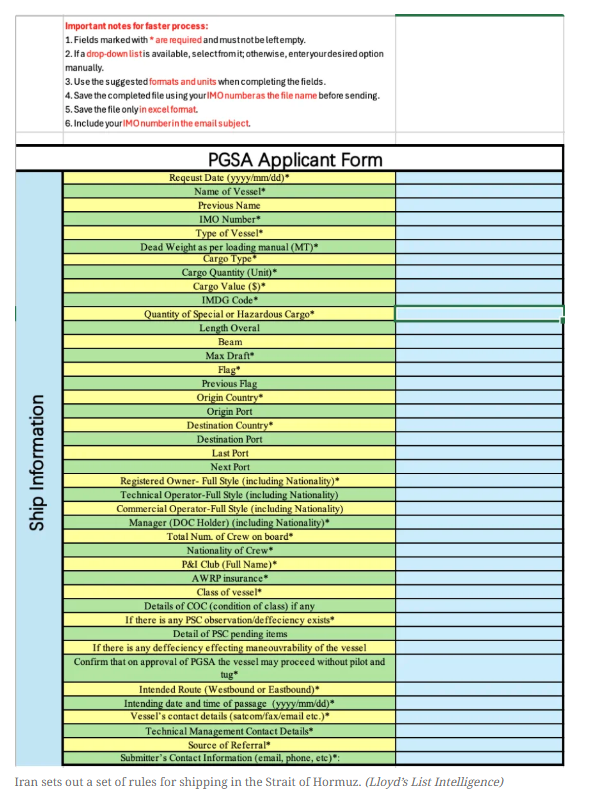
The PGSA has demanded that the form must be filled out with “complete and accurate information” and forwarded to them before any movement across the strait. It stated that “further instructions will be communicated via email” to the vessels following the processing of transit applications. It further threatened that the applicant would be solely responsible for any inaccurate or incomplete information supplied and any ensuing repercussions would be slapped accordingly.
Iran has not formally declared any preferential treatment for any nation attempting to cross the strait. Army official Mohammad Akraminia announced, “Countries that comply with the United States by imposing sanctions on the Islamic Republic of Iran will certainly face difficulties crossing the strait,” while talking to Iran’s official IRNA news agency.
He conveyed, “We have established a new legal and security system in the Strait of Hormuz. From now on, any vessel wishing to pass through it must coordinate with us.” The system, he further asserted, was “now in force” and would result in “economic, security, and political gains.”
“We warn governments, including microstates like Bahrain, that siding with the US-backed resolution will bring severe consequences. The Strait of Hormuz is a vital lifeline. Do not risk closing it on yourselves forever,” Ebrahim Azizi, chief of the Iranian parliament’s national security commission likewise remarked.
Iran has positioned the PGSA “as the only valid authority to grant permission to ships transiting the straits,” according to Lloyd’s List editor-in-chief Richard Meade. The Islamic regime has previously threatened to prevent ships connected to the US or Israel from passing through the strait while other ships could only do so with Iranian permission. India is one of the countries that has negotiated with Tehran to allow their flagged ships to pass.
Iran also declared the establishment of a “control area” that would stretch from the Gulf of Oman into the Gulf. According to reports, the planned zones encompass commercially significant waterways. One boundary runs from western Qeshm Island to Umm Al Quwain, while another extends from Mount Mobarak in Iran to Fujairah in the United Arab Emirates.
Tehran has blocked the strait since the start of the war on 28th February, enabling only a handful of ships to get through. The action initiated the most significant oil supply disruption ever recorded, resulting in soaring energy prices.
Iran stated time and time again that it wants to impose a new reality in the strait by charging tolls to passing ships and splitting the proceeds with Oman. Iran’s deputy speaker of parliament, Hamidreza Hajibabaei, announced last month that the country obtained its first toll from the strait.
