

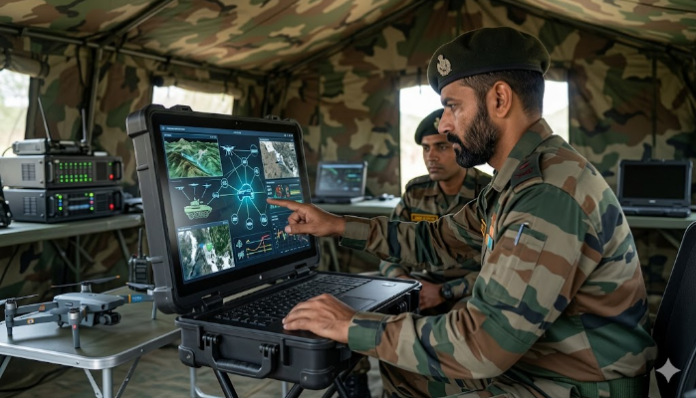
The continuing dispute in West Asia is being assessed by the Indian defence establishment as its focus has switched to providing the military with accessibility to artificial intelligence (AI) technologies produced within the nation, reported The Indian Express. There is a deliberate effort to separate vital areas from foreign-made technology.
According to three senior government insiders, the defence ministry is presently discussing how the technology might be linked with India’s current defence capabilities with indigenous firms such as SarvamAI and BharatGen which have created domestic AI models. An official unveiled, “The idea is to have an Indian version of Palantir as soon as possible.”
Another official revealed that even though India is behind the curve, investing in a core model of our own has an increasing strategic necessity. The confrontations in Iran and Ukraine have demonstrated to New Delhi that technology has the potential to revolutionise both offensive and defensive campaigns. The armed forces of these nations are reported to have successfully implemented AI to make operational moves.
Systems developed through companies like Palantir were employed in Washington operations against Tehran. Cyberattacks on digital infrastructure have also been carried out using this technology. Furthermore, China is rapidly incorporating AI into military activities as part of the People’s Liberation Army’s (PLA) mission for “intelligentized warfare.”
AI is being used by Chinese military planners for independent drone swarms, surveillance, target recognition, battlefield decision-making and command systems that can comprehend combat data in a matter of seconds.
AI-driven command-and-control along with reconnaissance systems are heavily emphasised in recent analyses of PLA procurement records, with the intention of accelerating operations and offsetting US military capabilities. China has also demonstrated autonomous drone platforms and robotic “wolf pack” fighting weapons motivated by AI.
The Military-Civil Fusion (MCF) initiative is a prime example of China’s military technology ambition. By 2049, the goal is to create the most advanced military in the world by combining the defence industry with academia and civilian technology. It is supervised by President Xi Jinping and concentrates on acquiring, creating and utilising dual-use technology like aircraft, quantum computing and artificial intelligence.
However, according to Pranay Kotasthane, deputy director of the Takshashila Institution, author and researcher in semiconductor, geopolitics, and policy, computer vision and autonomous systems are the AI that matters most in warfare today, not large language models (LLMs) for New Delhi.
Similarly, for important fields like defence, the Indian government and military institution maintain that domestic alternatives would be preferable. An officer mentioned, “Using American AI models to build products as wrappers on top of them might work in other business fields, but when it comes to strategic sectors, it is clearly being felt that there is a need to have our own technology, at least invest in them and build them, so that we are not reliant on something that we source from outside.”
Comprehensively big models, such as those designed in the United States, have not yet been produced in India but the military believes there is value in using locally produced tiny models to be applied on the ground. A senior official disclosed, “Such AI can still help guide our autonomous systems for surveillance, reconnaissance and target mapping, and aid in intelligence fusion.”
The process of combining, evaluating, and integrating data from several sources consisting of signals, imaging, and human intelligence to produce a cohesive, actionable and real-time representation of challenges is known as intelligence fusion in the military. The concept is developing into Intelligence Fusion Systems, which use machine learning and artificial intelligence to handle information quickly and shorten the time between gathering data and decision-making.
A source stated, “From our conversations with local players, what we have understood so far is that the difference in models that have been built domestically by companies like Sarvam and BharatGen is not that much when compared with Deepseek, or at least the gap can be bridged, even though there might be a lag. But we need our own model, no question about that.”
The cost of developing AI models is another factor contributing to it. Large, general-purpose language models, involving those developed by OpenAI and Anthropic, need significant financial outlays. The expense of computing alone is roughly $200 million, while the cost of data training and annotation can reach $500 million to $600 million. On the other hand, smaller models that are optimised for particular uses could be less expensive to construct.
Compared to some of their Western rivals, Indian entities could find it difficult to match their computing access. However, under the IndiaAI Mission, the government has attempted to alleviate that disadvantage by giving them GPUs at reduced usage rates. Senior US government officials also stated that the US expected its partners, including India, to build their AI solutions on top of the “America AI stack.”
The remarks had irritated New Delhi at the time. During “Operation Sindoor,” the Indian forces employed AI cloud-based integrated air command and control systems to identify and locate any hazardous objects in the sky.
Lt General Dinesh Singh Rana, chief of the Strategic Forces Command, disclosed that the Army had used AI predictive techniques to foresee and thwart a Chinese attempt along the Line of Actual Control (LAC) in Yangtse, Arunachal Pradesh, during the India AI Impact Summit in February. He stated, “We could see through some AI systems that something was building up. Finally, we were able to predict the timing of their move.”
Rana called the Chinese action “unprecedented” and pointed out that prompt AI-enabled intelligence guaranteed efficient force placement and evacuation planning, leading to “no Indian casualties.”
“It’s a great achievement for the Indian industry and most of confederation of Indian Industry and SIDM to organise this seminar today on how AI can be leveraged in the defence forces. Indian Army is confident that with Indian industry co-partnering, co-chairing and sharing our vision will partner to develop the global best solutions wherein our operational efficiency, our commanders, our soldiers on ground as well as the country at large will be hugely benefited,” conveyed Major General VTS Varaich, Additional Director General (Information Systems) of the Indian Army during the same summit.
A top official mentioned, “Even if our start-ups are able to build AI-led systems for military use cases, the underlying hardware that is powering those, including the graphics processing units crucial for computing power, are currently all made by foreign companies. We don’t have that level of technology at our disposal yet, but it is something that has to be ensured in the coming years,” while talking to The Indian Express.
