

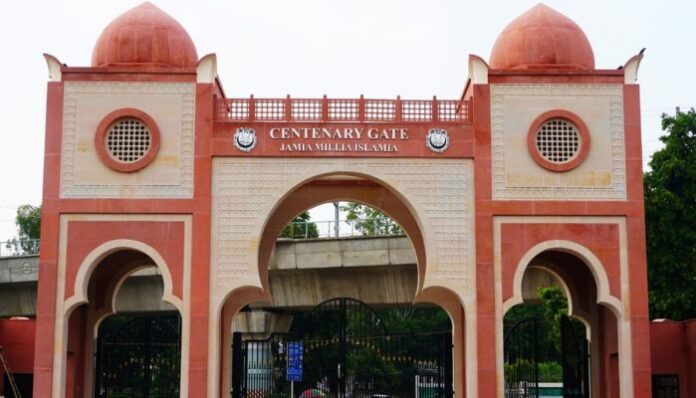
A petition filed in the Delhi High Court has raised questions over the hiring process of non-teaching staff at Jamia Millia Islamia, claiming that the private outsourcing agency working with the university has recruited employees mostly from “one particular community”.
The matter came up for hearing before a bench of Chief Justice DK Upadhyaya and Justice Tejas Karia on Wednesday, 13th May, after a Public Interest Litigation (PIL) was filed by Ram Niwas Singh, an employee of the university.
PIL questions the recruitment pattern
The petition challenged a notification issued by JMI on March 24, through which the university approved the continued engagement of 986 outsourced non-teaching employees hired through a private firm named Everest Human Resource Consultants.
According to the petition, out of these 986 workers, nearly 720 belong to a single community. Singh argued that this points towards a biased recruitment pattern and leaves out many equally qualified candidates from other communities.
The PIL stated that the recruitment process should remain fair and should not be influenced by religion in any form. Singh also sought fresh tendering for outsourced staff appointments so that recruitment becomes more inclusive.
The court asks questions to university
During the hearing, senior advocate Arun Bhardwaj, appearing for Singh, argued that both the Constitution and the Jamia Millia Islamia Act, 1988, do not allow discrimination in recruitment.
He clarified before the court that the issue was not with outsourcing itself, but with the way the outsourcing agency was selecting employees. Bhardwaj questioned whether a university could indirectly do something through a private agency that it cannot legally do directly.
Responding to the submissions, the bench also raised concerns over the large number of recruits from one denomination. Chief Justice Upadhyaya orally observed that while the facts were not disputed, the university still needed to explain why almost the entire outsourced workforce belonged to one community.
The court further asked whether the outsourcing agency was required to follow the principles of the Jamia Act and whether the university had included any clause in its tender asking the agency to ensure inclusivity in recruitment.
Jamia says recruitment is based on merit
Appearing for JMI, advocate Pritish Sabharwal defended the university and argued that hiring people from any particular community does not automatically violate Article 16 of the Constitution, which deals with equality in public employment.
He told the court that India is a secular country and people from every religion have the right to apply for jobs. Sabharwal also said that contractual and outsourced workers are engaged in many institutions, including courts, and their appointments cannot be questioned merely because they belong to a particular religion or region.
According to him, recruitment through the outsourcing agency was done purely on merit. He also argued that if candidates from another community had been selected in larger numbers, then complaints from other sides could also arise.
HC seeks details on posts and staff
The High Court also sought detailed information from the university regarding the nature of these posts. The bench asked JMI to clarify whether the 986 positions were sanctioned posts or non-sanctioned ones.
The court further directed the university to provide details about employees working on a daily wage, on a contractual basis, and the categories of posts currently available in the institution.
After issuing notice in the matter, the Delhi High Court directed JMI to file an affidavit with complete details. The next hearing in the case has been scheduled for 11th September.
