

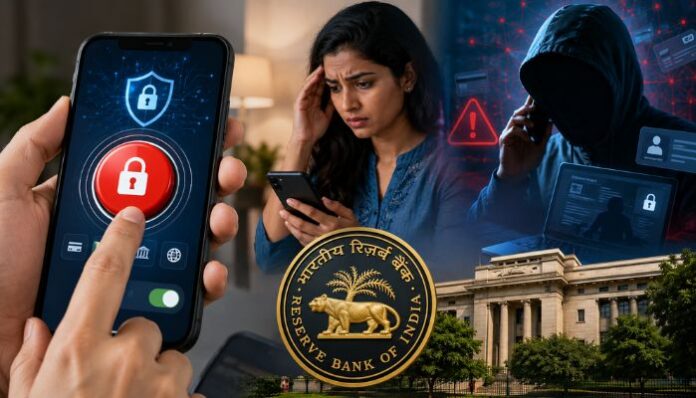
As digital payment frauds continue to rise across the country, the Reserve Bank of India (RBI) is examining a new security mechanism called a “Kill Switch” that could help people stop financial transactions from their accounts the moment they suspect a scam.
This initiative has been referred to by the RBI in its latest Annual Report as a means to enable customers to immediately prevent any financial loss in emergency conditions, particularly where criminals pressurise victims to make payments.
How will the ‘kill switch’ work?
The proposed kill switch is expected to function as an emergency control that can immediately freeze or block banking transactions. One of the ideas being considered is an emergency button within banking or payment applications that customers can activate if they feel they are being targeted by fraudsters.
Once triggered, the feature could temporarily stop all outgoing financial transactions from the account, preventing money from being debited while the customer verifies the situation with the bank or authorities.
The concept is currently being examined by the RBI and the government. Earlier this year, reports indicated that a high-level committee set up by the Ministry of Home Affairs (MHA) to address the growing problem of “digital arrests” was also looking at the possibility of introducing such a mechanism.
Why is such a feature needed?
The move comes amid a sharp increase in cases of digital fraud, particularly so-called “digital arrest” scams. In these scams, fraudsters pose as police officers or officials from law enforcement agencies through phone or video calls. They often use leaked personal information to appear genuine and tell victims that they are under investigation for serious offences.
To create panic, scammers show fake identity cards, forged documents and even fabricated arrest warrants. Victims are sometimes kept on calls for several hours and are pressured into transferring large sums of money to avoid supposed legal action.
According to estimates, people across India have lost nearly ₹3,000 crore to digital arrest scams. The issue became so serious that the Supreme Court took suo motu cognisance of the matter in October last year.
The RBI believes that if a person suddenly suspects that a demand for money is fraudulent, the kill switch could provide a quick way to halt transfers before funds leave the account.
RBI is also considering ‘switch on, switch off’ controls
Along with the kill switch proposal, the RBI is exploring a broader “switch on/switch off” facility for digital payment services. At present, customers can enable or disable domestic and international transactions on their debit and credit cards. This allows them to use the card only when required and keep it inactive at other times for added security.
The central bank now wants to study whether a similar system can be extended to other payment channels such as UPI, internet banking and other electronic payment modes. Under the proposed system, customers could temporarily turn specific banking services on or off whenever they choose.
For example, users may be able to disable UPI transactions, internet banking access, Debit and credit card usage, international transactions and ATM withdrawals. The services could then be switched back on whenever needed through a banking app, internet banking portal or other approved channels.
Aim for more control and better protection
According to the RBI, extending such controls to digital payment systems could strengthen customer protection, improve security against fraud and give users greater control over how their banking services are used. Together, the proposed kill switch and switch-on/off facility are being seen as important steps towards making digital payments safer and boosting consumer confidence in India’s fast-growing digital payment ecosystem.
