

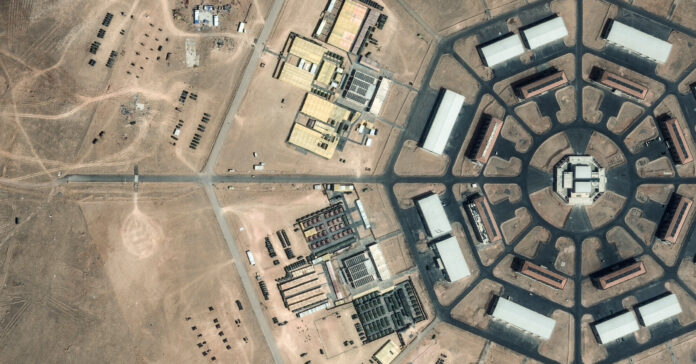
Deep in the barren expanses of China’s northwestern desert, an enormous military infrastructure project is quietly taking shape, one that security experts believe is designed to guarantee Beijing’s ability to launch a devastating nuclear retaliation even after absorbing a potential first strike from the United States.
Satellite imagery reviewed by Reuters has uncovered an extensive network of launch pads, fortified bunkers, communications hubs, and support facilities emerging around China’s strategic missile silo fields in Xinjiang. The scale of the construction has surprised even veteran nuclear analysts, who describe it as one of the most ambitious defensive military projects ever observed.
More than 80 launch sites identified
The images reveal over 80 prepared sites that analysts believe could support mobile missile launchers, air-defence systems, electronic warfare assets, and command-and-control operations. The infrastructure is centred around two massive octagon-shaped military complexes built over the past six years southwest of the Hami missile fields, which house some of China’s most powerful intercontinental ballistic missiles (ICBMs).
These complexes are connected through a sprawling web of roads and underground conduits stretching across thousands of square kilometres of desert terrain. Experts suggest the network could provide secure communications, rapid deployment capabilities, and enhanced survivability for China’s nuclear forces in the event of a conflict.
Building a credible second-strike capability
China’s nuclear doctrine is officially based on a “No First Use” policy, under which Beijing pledges not to initiate a nuclear attack. However, maintaining the ability to retaliate after suffering a nuclear strike remains central to its deterrence strategy. Analysts believe the newly emerging infrastructure is specifically intended to strengthen that second-strike capability.
While China can already launch nuclear weapons from submarines and strategic bombers, its silo-based missile force located in Xinjiang and neighbouring Gansu province continues to form the backbone of its nuclear arsenal. The latest developments suggest Beijing is investing heavily in ensuring those assets remain operational under virtually any circumstances.
Military activity already underway
Recent satellite images show large military vehicles, temporary structures, and activity around the northern octagonal installation. Analysts have also identified what appear to be camouflaged launch positions and air-defence deployments in the surrounding area. Nearby airfields, railheads, armoured bunkers, and weapons storage facilities further point to a highly integrated military ecosystem being established around the missile fields.
Experts believe some of the larger launch pads could eventually accommodate road-mobile ICBM launchers, adding another layer of complexity to any adversary’s targeting plans. Other facilities may support satellite communications, electronic warfare, and strategic command functions.
Growing nuclear competition with the US
The revelations come amid increasing strategic rivalry between Washington and Beijing, particularly over Taiwan. Although China insists its nuclear posture remains defensive, Western analysts have repeatedly expressed concern over the rapid pace of the country’s military modernisation and the limited transparency surrounding its nuclear programme.
According to the Pentagon’s latest assessment, China is on course to possess around 1,000 nuclear warheads by 2030. It is also strengthening its missile early-warning systems, enabling Chinese commanders to detect incoming attacks and potentially launch retaliatory strikes before their own missiles are destroyed.
“An extraordinary effort”
For many experts, the most striking aspect is not merely the size of the infrastructure but its apparent purpose. Unlike the United States and Russia, which largely rely on hardened silos and numerical superiority to ensure deterrence, China appears to be creating an extensive defensive and support ecosystem around its missile forces.
Hans Kristensen, director of the Federation of American Scientists’ Nuclear Information Project, summed up the scale of the undertaking succinctly: “I’ve never seen anything quite like it. It’s an extraordinary effort.”
As geopolitical tensions continue to rise across the Indo-Pacific, the rapidly expanding military complex in China’s deserts offers a stark glimpse into how seriously Beijing is preparing for a future where nuclear deterrence remains central to great-power competition.
