

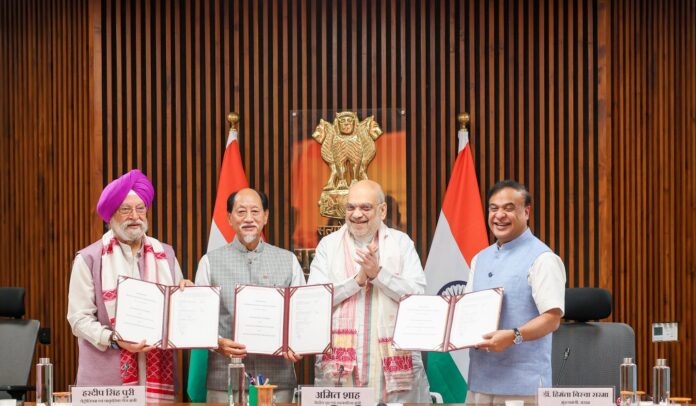
In a landmark development that promises to significantly boost India’s domestic hydrocarbon production and reduce dependence on imported crude oil, a historic tripartite Memorandum of Understanding was signed on June 11, 2026, in New Delhi. The agreement between the Ministry of Petroleum & Natural Gas of the Government of India, the Government of Assam and the Government of Nagaland paves the way for fresh oil and mineral exploration in the long-disputed area along the Assam-Nagaland border, ending a decades-long impasse that had kept the region’s rich hydrocarbon resources locked away.
The MoU, signed at the Ministry of Home Affairs in New Delh in the presence of Union Home Minister Amit Shah, Chief Minister Neiphiu Rio of Nagaland and Chief Minister Himanta Biswa Sarma of Assam, creates a clear framework for operational continuity, regulatory coordination and long-term investment in the Naga-Schuppen Belt of the Assam-Arakan Basin.
The agreement seeks to facilitate exploration and production activities across more than 1,000 square kilometres of land along the 434-km Assam-Nagaland boundary, an area believed to hold substantial hydrocarbon and mineral reserves. ONGC had begun limited production in Wokha district way back in 1980-81, but operations were suspended in May 1994 following government directives amid mounting jurisdictional disputes and law-and-order concerns.
For decades thereafter, Nagaland effectively blocked meaningful exploration activities across the state, citing protracted border disagreements with Assam over the disputed area belt and persistent security challenges caused by insurgency in the state that made sustained operations impossible. However, in recent years, the civil society in Nagaland has been urging the resumption of exploration. Last year, Naga Hoho, the apex body of Nagas, urged the Nagaland and Assam governments to address the issue of oil exploration in disputed areas along the interstate border by signing an oil exploration and production pact.
The Nagaland Schuppen Belt is estimated to hold 555 million metric tonnes of oil equivalent in prognosticated resources, yet only about three per cent of that potential has been established so far, compared with Assam’s far more developed reserves. With the new agreement in place, exploration activities are expected to resume in earnest, potentially increasing output from the present modest levels of around 1,000 to 1,500 barrels per day to several times that figure.
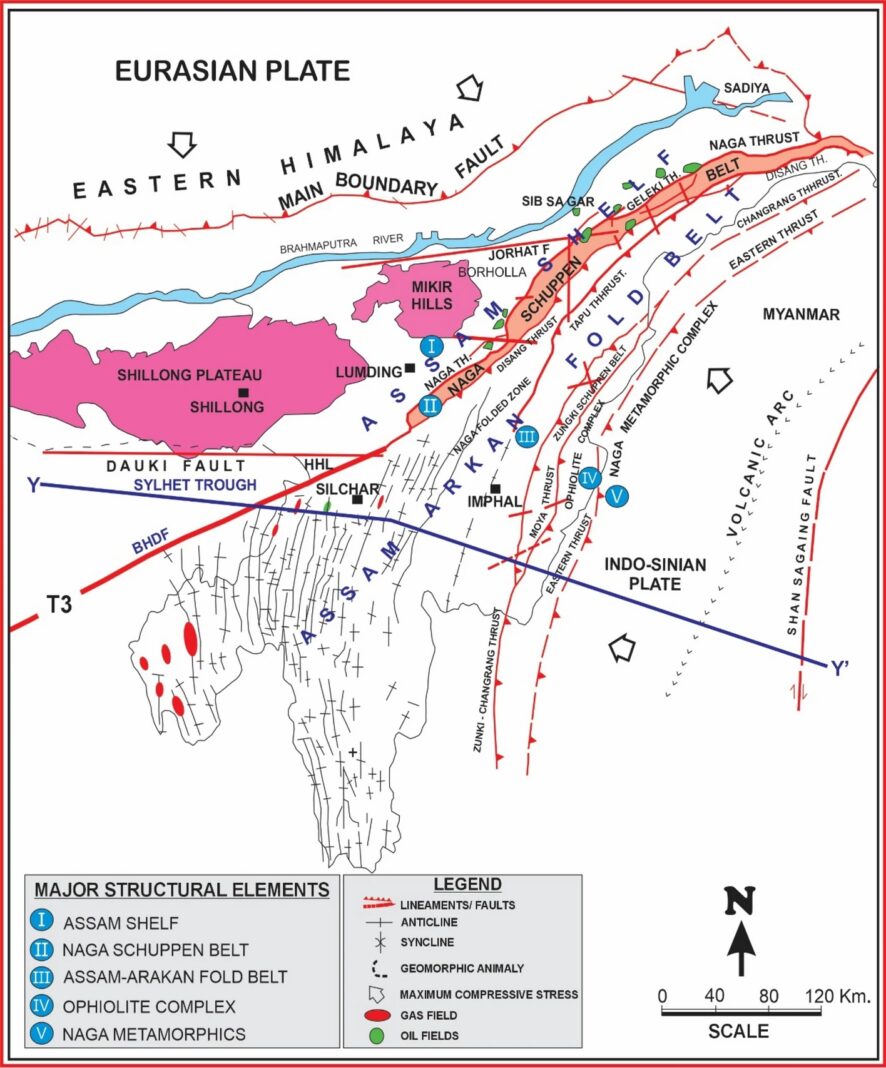
Officials pointed out that even a single field could yield recoveries worth over ₹15,000 crore, generating direct and indirect employment, boosting local entrepreneurship, strengthening infrastructure and contributing substantially to the economic development of surrounding communities across the Northeast.
The Tripartite MoU unlocks the economic potential of Sectors A, B, C, D, E & F along the Nagaland-Assam border, turning an area of uncertainty into a vibrant corridor of economic growth.
Petroleum Minister Hardeep Singh Puri noted that the North East gave birth to India’s petroleum industry and is now poised to power the next phase of the country’s energy journey under the Atmanirbhar Bharat push. He posted on X, “Since Assam alone accounts for nearly 22% of India’s crude oil reserves and around 15% of the country’s natural gas reserves, while Nagaland possesses significant hydrocarbon potential in the Naga-Schuppen Belt of the Assam-Arakan Basin, resources where hydrocarbons flow naturally and those which have huge untapped resources, the outlook for E&P activities in the North East is therefore extremely promising.”
The North East gave birth to India's petroleum industry; today, it stands ready to power the next chapter of India's energy journey as Nagaland will produce oil and gas again after 31 years!
— Hardeep Singh Puri (@HardeepSPuri) June 11, 2026
With the signing of a historic tripartite Memorandum of Understanding between Ministry… pic.twitter.com/LX6vQtwY8S
The minister stated that by creating a framework for cooperation between the concerned Governments, the MoU provides certainty to investors, facilitates operational continuity, enables regulatory coordination and creates conditions necessary for long-term investment decisions.
Union Home Minister Amit Shah described the pact as a defining moment of cooperative federalism that removes major obstacles to Prime Minister Narendra Modi’s vision of a developed and self-reliant Northeast, while Petroleum and Natural Gas Minister Hardeep Singh Puri hailed it as the reopening of Nagaland’s oil and gas chapter after 31 long years.
A historic tripartite MoU has been signed by Govt. of India, Govt. of Assam and Govt. of Nagaland ending a decades-long dispute in the Northeast and opening way for oil & gas exploration in the region. It stands out as an exemplar of India's unity, where both the states give up… pic.twitter.com/1x7vfGnoKS
— Amit Shah (@AmitShah) June 12, 2026
Amit Shah emphasised that the pact exemplifies the spirit of unity and compromise, with both states setting aside long-standing differences to advance national energy security. He also highlighted the broader improvement in the regional security situation, noting that twelve peace accords signed since 2019 have led to an 80 per cent decline in violent incidents and that the Armed Forces (Special Powers) Act is on course to be withdrawn from most Northeastern states by next year. Chief Minister Rio termed the signing a historic day for Nagaland, while Chief Minister Sarma welcomed the cooperative framework that would benefit both states and the nation at large.
Today is a historic day with the signing of the Tripartite MoU for "Mineral Oil Operations in the Assam Nagaland Boundary Areas" between GoI, Assam Govt. & Nagaland Govt., in the presence of Hon'ble Union HM Shri @AmitShah Ji & Union Min. for @PetroleumMin Shri @HardeepSPuri Ji. pic.twitter.com/wxpxt4h8e1
— Neiphiu Rio (@Neiphiu_Rio) June 11, 2026
Nagaland Chief Minister Dr. Neiphiu Rio said that it was a historic day for the state. He said, “For decades, unresolved issues along the Nagaland-Assam border limited the development of resources in the area. Today’s MoU transforms years of dialogue into a framework that will benefit present and future generations.”
Himanta Biswa Sarma said that the agreement was a decisive breakthrough and an example of cooperative federalism. He said the pact reflects the Modi government’s commitment to resolving complex, long-pending issues that have historically hindered development and resource utilisation in the region.
The development comes at a time when the Centre is keen to accelerate domestic exploration and production to meet rising energy demand and cut import bills. With the decades of blockage now lifted through dialogue and mutual accommodation, the Northeast’s untapped hydrocarbon wealth is finally set to play its rightful role in India’s quest for energy independence.
