

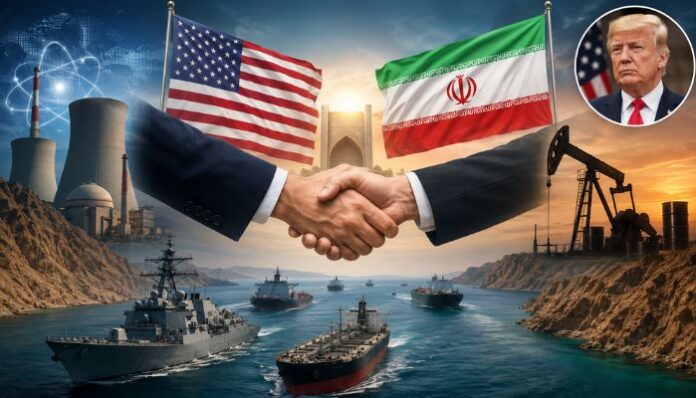
The United States and Iran are moving closer to an initial agreement that could ease tensions between the two countries and pave the way for wider negotiations over Tehran’s nuclear programme and economic sanctions. As per reports, Iran will open the Strait of Hormuz as part of the deal, and the US will also withdraw its naval blockade on the vital waterway.
Iranian Foreign Minister Abbas Araghchi said the two sides may announce an initial understanding in the coming days. He said the proposal is based on a 14-point memorandum of understanding and would be followed by about 60 days of talks on unresolved issues.
Strait of Hormuz to reopen
According to a senior Iranian official, the draft agreement calls for Iran to immediately reopen the Strait of Hormuz to all commercial ships. In return, the United States would begin lifting its naval blockade on Iranian ports, with the process expected to be completed within 30 days.
The official said the draft is intended to create conditions for broader negotiations and reduce tensions in the region.
Nuclear restrictions and future talks
Under the proposed framework, Iran would pledge that it will not produce or obtain nuclear weapons. Until a final agreement is reached, Tehran would keep its nuclear programme at its current level, avoiding any further uranium enrichment or expansion of nuclear facilities.
The draft also states that the United States would allow Iran to dilute its stockpile of highly enriched uranium inside the country under a future comprehensive agreement. The details of Iran’s enrichment activities, nuclear programme and uranium stockpile would be negotiated during the 60-day follow-up talks.
Sanctions relief and frozen funds
The proposal includes several economic measures aimed at providing relief to Iran. Washington would refrain from imposing new sanctions while negotiations continue and would temporarily waive oil sanctions, allowing Iran to export oil and receive the proceeds.
The draft further provides for the release of $25 billion in Iranian assets frozen abroad. The funds would be made available through direct transfers, financial credit lines and cooperation with regional countries.
It also calls for the United States and its regional partners to prepare a reconstruction and development plan for Iran, which would be negotiated within the next 60 days.
Qatar steps in
As diplomatic efforts continue, a Qatari delegation arrived in Tehran on Sunday, 14th June for discussions with Iranian officials. The delegation is led by an adviser to Qatar’s Prime Minister and Foreign Minister Sheikh Mohammed bin Abdulrahman bin Jassim Al Thani and is taking part in ongoing exchanges of messages between Tehran and Washington.
Meanwhile, US President Donald Trump said on Truth Social that the agreement was expected to be signed on Sunday, the 14th of June and that the Strait of Hormuz would open to all vessels immediately afterwards. He described the proposal as a barrier against nuclear weapons and drew a contrast with the 2015 nuclear deal reached under former President Barack Obama.
Araghchi also stressed that any future agreement must include clear guarantees to ensure that neither side backs away from its commitments.
