

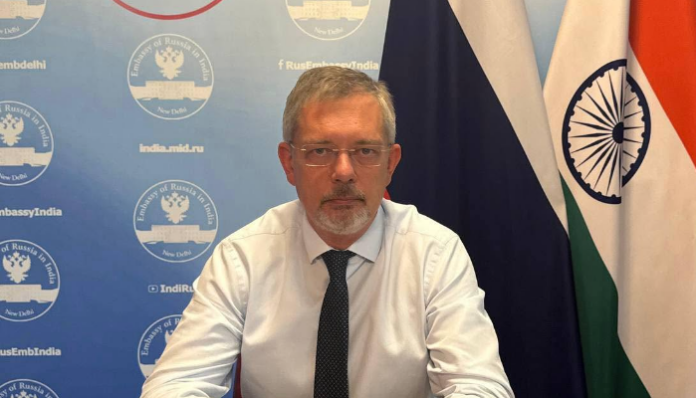
In a recent interview, Russian Ambassador to India Denis Alipov reflected on the robust basis of India-Russia relations and emphasised that Moscow’s connections with Beijing would not impact its historical ties with New Delhi.
“We will never allow our relationship with China to affect our ties with India, and vice versa. Russia maintains independent and self-sustaining relationships with both China and India, as well as with many other countries. India remains one of the highest priorities in our foreign policy and economic engagement,” he stated, in an interview with The Indian Express.
Alipov clarified that although Russia’s ties with China have expanded considerably, the former has been completely consistent in its intention for alliance with India to be as extensive and intensive. He noted, “India is a pragmatic and business-oriented country, although it has at times approached certain areas of cooperation with caution. Nevertheless, we have continued to make progress, which reflects India’s desire to diversify its economic partnerships.”
He maintained that there is a rising urge to boost engagement in a variety of fields, such as labour mobility, industry, agriculture, energy, nuclear power, defence, space, culture, and humanitarian exchanges.
Alipov highlighted that Soviet Union supported India’s decolonisation campaign and mentioned that the two sides have been “close friends” since before India gained independence. He added, “Our relationship is built on a remarkably stable foundation. While we may differ on minor issues, we have never disagreed on matters of major international importance or on issues affecting our respective national interests.”
The envoy mentioned that to ensure stable, balanced and mutually beneficial economic connections, one of the main goals of the present bilateral dialogue is to increase Indian exports to Russia to resolve the trade deficit. He declared, “India is an indispensable strategic partner for Russia, just as Russia remains an indispensable strategic partner for India.”
Alipov also conveyed that due to its profound comprehension of the fundamental circumstances, India’s stance has remained constant throughout the conflict in Ukraine. “For many years, we have moved beyond a simple supplier–buyer relationship towards a model based on co-production and co-development. Only a few days ago, I spoke at a seminar marking the 25th anniversary of the BrahMos joint venture. Two-and-a-half decades later, India has institutionalised the principle of self-reliance in defence through the Make in India initiative,” he elaborated while explaining that the war has no “serious impact” on defence cooperation between the two partners.
The diplomat asserted that Russia takes pride in having pioneered a “central pillar of India’s defence policy” and outlined that T-90 tanks, Kalashnikov rifles, Su-30MKI planes and BrahMos missiles are parts of this strategy. “We are keen to expand cooperation through new projects. Deliveries of the S-400 system are proceeding according to the mutually agreed schedule. Four of the five regiments have already been delivered, and we expect to complete the contract by the end of the year,” he expressed.
“We are keen to expand our financial relationship, including by increasing the presence of Russian banks in India and encouraging more Indian banks to operate in Russia,” Alipov stated. He informed that the Vande Bharat project contract was awarded to Russia and the work is moving forward as planned. The first prototype could be introduced by the end of this year. The train is being produced in India with local materials and parts.
Alipov further insisted, “Our trade with China was expanding well before 2022. At the same time, we remain determined to deepen our economic relationship with India, although the response from the Indian side has been more cautious. The assumption that Russia’s relationship with China should automatically be viewed as a sensitive issue for India is fundamentally mistaken. A broader and more diversified economic partnership between Russia and India would help alleviate such concerns.”
He underlined that the government is not to blame for the hesitancy. However, Russia is aware that the financial and commercial groups are inherently more cognisant of the effects of sanctions. India’s economy is intricately linked to international financial and commerce networks. India would not want to jeopardise its links with the US and Europe for the sake of its relationship with Russia.
Alipov argued, “My point is that Western sanctions interfere in what should be a bilateral relationship between Russia and India. These are matters that do not concern third parties. We see this as a manifestation of a neo-colonial mindset, the notion that others know better than India what India’s interests should be. Such pressure tactics are illegitimate and should be rejected.” He termed sanctions as a “political instrument of pressure” and added that about 38% of India’s total imports of crude oil came from Russia as of May of this year.
“The project remains on track and will ultimately be implemented. Once completed, it will make a significant contribution to meeting India’s agricultural requirements and further strengthen cooperation between our two countries in the fertiliser sector,” he expressed while talking about India’s two-million-tonne urea joint venture with Uralchem Group.
He also mentioned that there are no Indian nationals in the Russian military. They stopped admitting Indian volunteers around two years ago, at the behest of the Indian government.
