

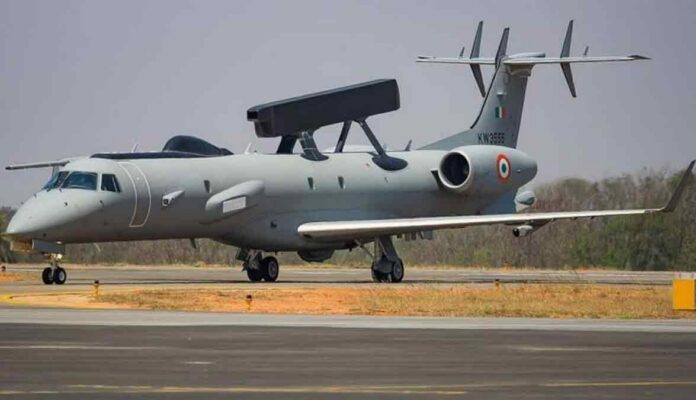
In a defining moment for India’s defence self-reliance, the Indian Air Force today received the Final Operational Clearance (FOC) certificate for the indigenous ‘Netra’ Airborne Early Warning and Control (AEW&C) system from the Defence Research and Development Organisation (DRDO). The formal handover, held at the Centre for Airborne Systems (CABS) in Bengaluru, marks the culmination of years of dedicated indigenous development and rigorous testing, elevating the IAF’s airborne surveillance, situational awareness and battle management capabilities to a new level of operational maturity.
The event celebrated not just a technical milestone but the successful synergy between the armed forces, DRDO scientists and Indian industry that has defined the programme since its inception.
The Netra AEW&C, mounted on the Embraer ERJ-145 platform, is India’s first fully indigenous airborne early warning and control system. Conceived through a collaborative study initiated by the IAF and DRDO, the platform received Initial Operational Clearance (IOC) in 2017 and has since been operational with the IAF’s 200 Squadron. Its advanced Active Electronically Scanned Array (AESA) radar delivers 240-degree coverage with detection ranges extending from 250 km to over 375 km, depending on target radar cross-section, enabling real-time tracking of aerial threats, cruise missiles and surface targets. The system also integrates identification friend-or-foe (IFF), satellite datalinks, missile warning receivers and air-to-air refuelling for extended endurance, functioning as a true force multiplier in network-centric operations.
The successful grant of FOC assumes particular strategic significance against the backdrop of contemporary security challenges. In an era marked by advanced adversary air forces, proliferating drones, cruise missiles and integrated air defence networks, an indigenous AEW&C platform provides persistent wide-area surveillance, early warning and real-time battle management that directly enhances the survivability and effectiveness of IAF fighters, surface-to-air missiles and ground forces. Having already demonstrated its worth in live operations, Netra now stands fully combat-mission ready, reducing dependence on foreign suppliers and strengthening India’s strategic autonomy.
Beyond its immediate operational value, the programme exemplifies the success of the Atmanirbhar Bharat initiative in high-technology defence domains. The initial development of the three aircraft involved substantial indigenous effort in radar, avionics, mission systems and airframe modifications, fostering expertise and industrial capacity that will support future variants.
Plans are already underway for enhanced Netra configurations on larger platforms. Like the Netra Mk1, the Netra Mk1A AWACS aircraft will also be based on the Embraer EMB-145 platform, but the planned Netra Mk-2 systems will be integrated on the larger Airbus A321 airframe procured from Air India. Separately, the IAF is also planning for the procurement of six Airbus A330-based Netra Mk-3 AWACS platforms, which will feature a 360-degree fixed dome radar system.
