

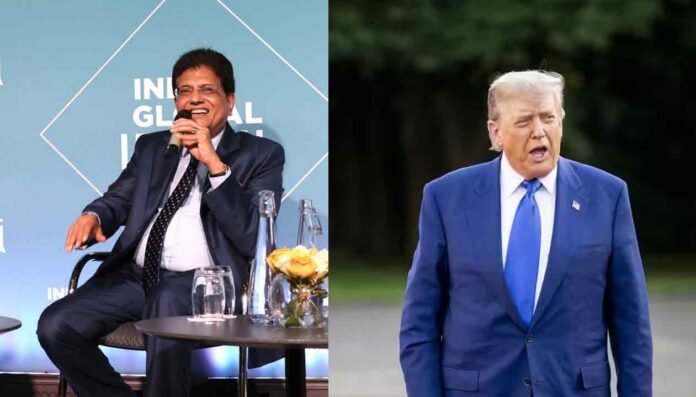
Commerce and Industry Minister Piyush Goyal has stated that while the proposed India-US bilateral trade agreement is very close to finalisation, India will not sign or activate the deal unless it secures a clear competitive tariff advantage over rival economies.
Speaking at the India Global Forum during the UK-India Week in London, Goyal said the framework of the agreement, announced on February 6 this year, had been negotiated around a lower tariff regime for Indian goods that gave the country an edge over competitors. However, recent developments in the United States, including the Supreme Court striking down sweeping tariffs and the impending expiry of the additional 10 per cent temporary levy on July 24, have altered the original calculations.
“The whole deal was centred around that competitive advantage that we got with 18 per cent over our neighbours and competing countries. So we were lower than all our neighbouring countries, lower than all ASEAN countries other than Singapore, that is why the deal was attractive for us,” Goyal said.
He emphasised that a free trade agreement is fundamentally aimed at providing a comparative advantage over competitor countries in terms of market access. India is therefore seeking appropriate legal tools and backing from the US side to restore and maintain this edge over economies at a similar stage of development or with comparable cost structures, including Vietnam, Thailand, the Philippines, Indonesia, China, Malaysia, Bangladesh, Sri Lanka and other neighbours.
Piyush Goyal: India Won't Activate US Trade Deal Until Competitive Edge Is Secured
— RT_India (@RT_India_news) June 25, 2026
The Indian Commerce Minister alluded that New Delhi is seeking clarity on how it will retain an edge over competing manufacturing economies before moving ahead with the deal.
He noted that the… https://t.co/labdIoYmfM pic.twitter.com/l7QU6qeEqk
“Until the framework of getting that competitive advantage can be finalised, we can’t enter into a forced US deal. I don’t think I can be more transparent than that,” Goyal remarked. “The day that happens, the deal is on.”
Goyal added: “With the US Supreme Court striking down Trump’s sweeping tariffs and now with the additional temporary levy expiring on July 24, we obviously have to have some reason to be able to enter into force that agreement that we have already agreed upon.”
The minister, who recently held two days of talks with US Trade Representative Jamieson Greer in New Delhi, described the negotiations as 99 per cent complete, with the remaining issues being resolved. He noted that there is always some give and take in such agreements, but India needs a clear reason to bring the framework into force amid the changed US tariff landscape.
When the framework of the first phase of the deal was finalised, India had a comparative advantage over its competitor countries in trade with the USA. The deal was negotiated to bring 50 per cent tariffs on India to 18 per cent. At that time, tariffs on India’s competing countries ranged from 19 to 20 per cent. But now, all countries face the same 10 per cent additional levy as the Supreme Court has abolished the reciprocal tariff imposed by Trump. Now, that 10% tariff is also expiring on 24th July, therefore 18% tariff is no longer competitive for India.
Officials from both sides have been working on the fine print of what is seen as the first phase of a broader bilateral trade agreement. The US remains India’s second-largest trading partner, with robust two-way trade flows recorded in the last financial year.
