

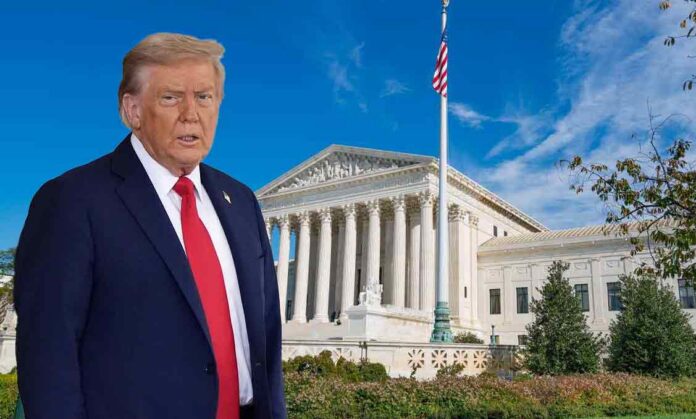
The U.S. Supreme Court on Friday struck down President Donald Trump’s sweeping global tariffs, ruling that he exceeded his authority by invoking a 1977 emergency powers law to impose duties on imports from nearly every trading partner worldwide.
In a 6-3 decision authored by Chief Justice John Roberts, the justices held that the International Emergency Economic Powers Act (IEEPA) does not authorise the president to levy tariffs, a power the Constitution reserves for Congress under Article I, Section 8. The court applied the “major questions doctrine,” which requires clear congressional authorisation for executive actions of vast economic and political significance.
“The president asserts the extraordinary power to unilaterally impose tariffs of unlimited amount, duration, and scope,” Roberts wrote for the majority, adding that IEEPA contains no reference to tariffs or duties.
NEW: The Supreme Court has held that IEEPA does not authorize the president to impose tariffs.https://t.co/BKgNq0lxKW
— SCOTUSblog (@SCOTUSblog) February 20, 2026
The ruling invalidates the core of Trump’s “Liberation Day” tariff program, launched in April 2025. That included a baseline 10% tariff on goods from most countries, justified as a response to persistent U.S. trade deficits declared a national emergency, along with higher rates on key partners: up to 145% on certain Chinese imports, 25% on most goods from Canada and Mexico, and elevated duties on the European Union, Japan, South Korea, India, and Brazil. These measures, the first-ever use of IEEPA for broad tariffs, have generated more than $130 billion, and by some estimates over $175 billion, in revenue collected by U.S. Customs and Border Protection.
According to the judgment, the US government has conceded that the president enjoys no inherent authority to impose tariffs during peacetime. “It instead relies exclusively on IEEPA to defend the challenged tariffs,” the rulling says, adding that the govt used “the words
“regulate” and “importation” to effect a sweeping delegation of Congress’s power to set tariff policy—authorizing the President to impose
tariffs of unlimited amount and duration, on any product from any country.”
The decision upholds lower-court rulings from the U.S. Court of International Trade and the Federal Circuit. It does not affect tariffs imposed under other statutes, such as national-security authorities in Section 232 of the Trade Expansion Act or Section 301 unfair-trade provisions.
Justices Sonia Sotomayor, Elena Kagan, Ketanji Brown Jackson, Neil Gorsuch, and Amy Coney Barrett joined Roberts in the majority. Justices Clarence Thomas, Samuel Alito, and Brett Kavanaugh dissented. In dissent, Kavanaugh argued that IEEPA’s text authorising the president to “regulate … importation” encompasses tariffs as a traditional tool of trade policy, consistent with historical precedent and congressional reenactments of the statute.
The court left unresolved what happens to the billions already collected, remanding refund and implementation issues to lower courts, a process that could prove administratively complex for importers.
Trump, who made aggressive tariffs a centerpiece of his 2024 campaign and second-term agenda, had warned that invalidating the tariffs would invite economic “payback” from trading partners and amount to an “economic disaster.”
