

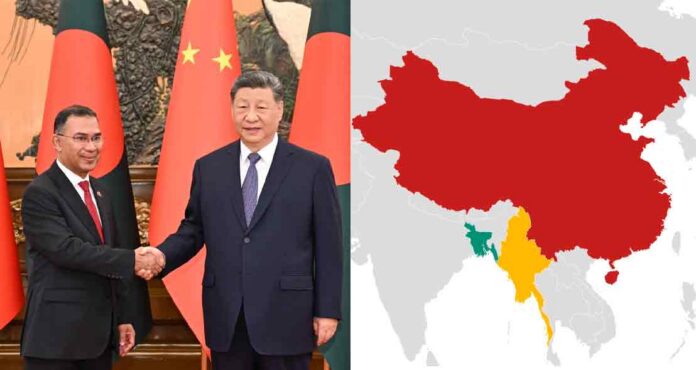
During Bangladesh Prime Minister Tarique Rahman’s official visit to China, Beijing has proposed development of the China-Myanmar-Bangladesh Economic Corridor under the Belt and Road Initiative to boost regional connectivity and economic integration across the three nations. The proposal came to the fore during high-level talks, marking a fresh push to realise greater infrastructure and trade linkages in the region.
Prime Minister Rahman, who is on his first major overseas trip since assuming office earlier this year, held detailed discussions with Chinese President Xi Jinping at the Great Hall of the People today. The two leaders jointly announced their decision to build a China-Bangladesh community with a shared future in the new era, thereby elevating bilateral relations to a higher strategic plane. President Xi reaffirmed China’s commitment to being a reliable friend and partner to Bangladesh, stressing support for the country’s sovereignty and development path while expressing readiness for high-quality Belt and Road cooperation.
President Xi highlighted the need to advance the China-Myanmar-Bangladesh Economic Corridor to foster stronger regional links.
In parallel, Premier Li Qiang and Prime Minister Rahman held bilateral talks yesterday during which several memoranda of understanding and cooperation agreements were signed. The two sides reached consensus on expanding collaboration in the Teesta Master Plan, river management, flood-risk mitigation, river dredging, erosion control, irrigation and inland navigation. A series of additional pacts covering trade, investment, infrastructure development, connectivity, water conservancy, healthcare and people-to-people exchanges were also concluded, with scope to extend cooperation into high technology, the green economy and the digital sector.
Prime Minister Rahman welcomed the elevation of ties and expressed Bangladesh’s keenness to deepen Belt and Road partnership with China. He underlined areas such as economy and trade, agriculture, technology, green energy, education and health as priorities for achieving the country’s modernisation goals. Bangladesh also reaffirmed its adherence to the one-China principle and support for China’s global initiatives aimed at promoting peace, development and international fairness.
Trade between the two countries, which stood at around 25 billion dollars last year with China as Bangladesh’s largest trading partner, is expected to receive further impetus from the new agreements.
The visit, which included Rahman’s participation in the Summer Davos forum in Dalian earlier in the week, is being viewed as a significant step in strengthening China-Bangladesh strategic coordination. Both sides expressed willingness to enhance exchanges at political party, subnational and cultural levels while working together in multilateral forums to uphold the interests of developing nations.
