

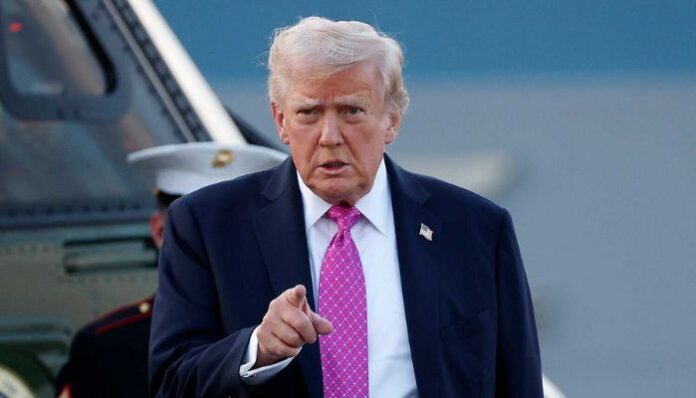
The United States carried out fresh military strikes on several Iranian targets on Saturday, 27th June, after accusing Tehran of breaking the recently agreed ceasefire. US President Donald Trump confirmed the action and warned that Iran could “no longer exist” if it continued attacking American interests.
Trump issues a strong warning
In a post on Truth Social, Trump said US aircraft had targeted Iranian missile and drone storage sites along with coastal radar facilities. He said Iran had once again violated the ceasefire agreement and warned that if the attacks continued, the US could go beyond limited strikes. “There may come a point when we are no longer able to be reasonable,” Trump wrote, adding that the Islamic Republic of Iran “will no longer exist” if forced into a larger military response.
US strikes follow an attack on oil tanker
According to US Central Command (CENTCOM), the strikes were launched after an Iranian one-way drone hit the oil tanker Kiku early Saturday. The vessel was carrying more than two million barrels of crude oil and was travelling through the Strait of Hormuz after leaving a Qatari oil field. It was heading toward a port in the United Arab Emirates using a shipping route near the coast of Oman.
CENTCOM said the US military struck Iranian surveillance systems, communication networks, air defence sites, drone storage facilities and minelayer capabilities. The military said Iran had been given a chance to follow the ceasefire agreement but chose not to.
Iran responds with missile and drone attacks
Iran’s Revolutionary Guard said it had fired ballistic missiles and drones at two US military bases in the region in response to the American strikes. Iran’s Foreign Ministry also said the US action violated both the UN Charter and the war-ending memorandum signed between the two countries.
Iranian state television later reported explosions in areas north of the Strait of Hormuz. Tehran did not identify the exact locations that were targeted.
Rising tensions in the Gulf
The latest exchange came just days after another incident in which Iran attacked a container ship trying to leave the Strait of Hormuz. Earlier this week, an explosive drone also damaged a Singaporean cargo ship, causing major damage to its bridge but no reported casualties.
Iran had also warned oil tankers that routes through the Strait of Hormuz were restricted and described alternative routes as “completely dangerous.” At the same time, Iran has insisted that ships must follow its directions and has even warned it could begin charging transit fees through the waterway. The US and Gulf Arab countries have rejected that demand, saying the strait is an international shipping route despite passing through the territorial waters of Iran and Oman.
Bahrain targeted, shipping route expanded
The conflict spread further after Bahrain said several Iranian drones targeted the country on Saturday. Bahrain, which hosts the US Navy’s Fifth Fleet, called the attack a serious threat to its security, though no damage was immediately reported.
Following the attacks, the Joint Maritime Information Centre, overseen by the US Navy, announced that the shipping route near Oman’s coast would now allow both inbound and outbound traffic. The move is expected to increase tensions as more ships avoid routes controlled by Iran.
Peace talks continue despite fighting
The latest military action comes even as Washington and Tehran continue talks on a long-term peace agreement. Under an interim memorandum signed last week, Iran agreed to make its best efforts to ensure the safe passage of commercial ships for 60 days while both sides negotiate a final deal.
The talks also cover Iran’s nuclear programme, its stockpile of highly enriched uranium and the future security of the Strait of Hormuz. Ending the fighting involving the Iran-backed Hezbollah group in Lebanon is also part of the broader negotiations.
US Vice President JD Vance, who is leading the talks for Washington, urged Iran to resolve disagreements through dialogue, saying that “violence will be met with violence” if attacks continue.
