

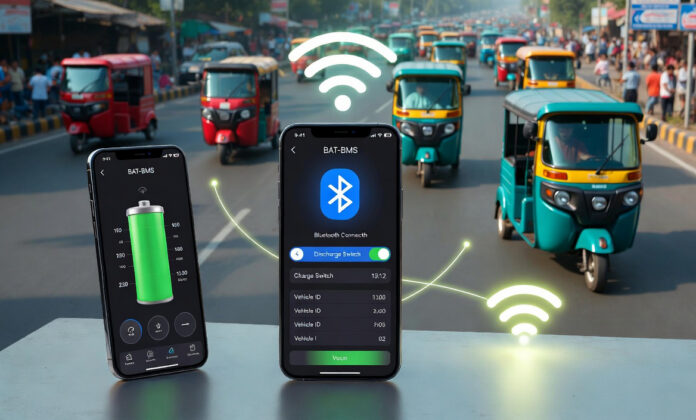
The Ministry of Electronics and Information Technology (MeitY) has ordered the removal of two mobile applications from app stores following widespread concerns over their alleged misuse to remotely disable e-rickshaws via Bluetooth.
Secretary S. Krishnan stated that a couple of apps came to the ministry’s notice and were promptly taken down from the app stores. He emphasised that app stores must exercise due care and that the government would engage with them to prevent similar potentially damaging applications from appearing.
#WATCH | Delhi | On removal of two apps which were being allegedly used to prank e-rickshaws from app stores, S. Krishnan, Secretary, MeiTY, says, "There are a couple of apps which came to our notice yesterday, and both the apps have been taken down from the app stores. App… pic.twitter.com/Es9PikIHjF
— ANI (@ANI) July 3, 2026
The apps in question, BAT-BMS and Epoch Li-ion, are battery management system (BMS) monitoring tools that connect to compatible lithium-ion batteries in certain e-rickshaws. While intended for legitimate monitoring and maintenance, they have been exploited in a viral social media trend known as the “Tirri Prank” or “Tirri Control,” where users remotely cut power to vehicles, stranding drivers.
BAT-BMS is developed by the Chinese company Shenzhen Grenergy Technology. It allows users to monitor key battery parameters such as voltage, temperature, current, charge status, cell health, and cycle life through a Bluetooth connection. On compatible systems, it also provides control functions for charging and discharging. Epoch Li-ion is a similar battery management app that offers comparable monitoring and control features.
After the videos went viral, BAT-BMS has been updated to require a password from the vehicle’s owner to control it. But other apps continue to allow control without permission.
How are e-rickshaws being controlled through mobile apps, and what is the Chinese angle behind this 'tirri trouble'?
— OpIndia.com (@OpIndia_com) July 2, 2026
What is the Battery Management System (BMS), and how is it forcing e-rickshaws to stall in the middle of the road?@jayeshmatiyal breaks down the full story… pic.twitter.com/FMfvWuDtx8
The vulnerability lies not primarily in the apps themselves but in the low-cost, aftermarket Bluetooth-enabled BMS units commonly used in many affordable e-rickshaws in India. These systems often lack password protection or authentication, allowing nearby devices, within typical Bluetooth range of about 10-15 meters, to connect to the module without any authorisation, and in some cases, flip the discharge switch to cut power to the motor.
E-rickshaws made by reputed companies like TVS or Mahindra are immune to this problem because they use modules with proper protection to prevent unauthorised remote connection and command. Similarly, higher-end electric vehicles, including passenger cars and two-wheelers, use more secure, encrypted, closed-loop BMS systems that are not susceptible to this type of remote interference.
Viral videos circulating on Instagram, YouTube, and X showed individuals approaching e-rickshaws, connecting via the apps, and abruptly stopping the vehicles mid-ride or while stationary. Clips often captured drivers’ confused or distressed reactions, with some incidents reportedly involving demands for payment to “unlock” the vehicle. Many pranksters justify the action claiming that e-rickshaws are nuisance on the road and they need to be taught a lesson.
E-rickshaw drivers, many of whom are daily-wage earners, reported being stranded and having to push their vehicles to safety. Dealers in Delhi noted a surge in complaints, with 40-50 affected vehicles brought to workshops over just a few days. In one reported case in Ujjain, police arrested a man accused of using such methods to extort money from drivers.
The trend raised serious road safety and livelihood concerns, prompting calls for bans and stricter regulation of connected vehicle components. MeitY acted swiftly after the videos gained traction.
Delhi Transport Minister Pankaj Singh directed the Transport Department and Delhi Police to investigate the claims. The Delhi government is verifying the allegations and assessing risks, though no formal written complaints had been received at the time of initial statements.
